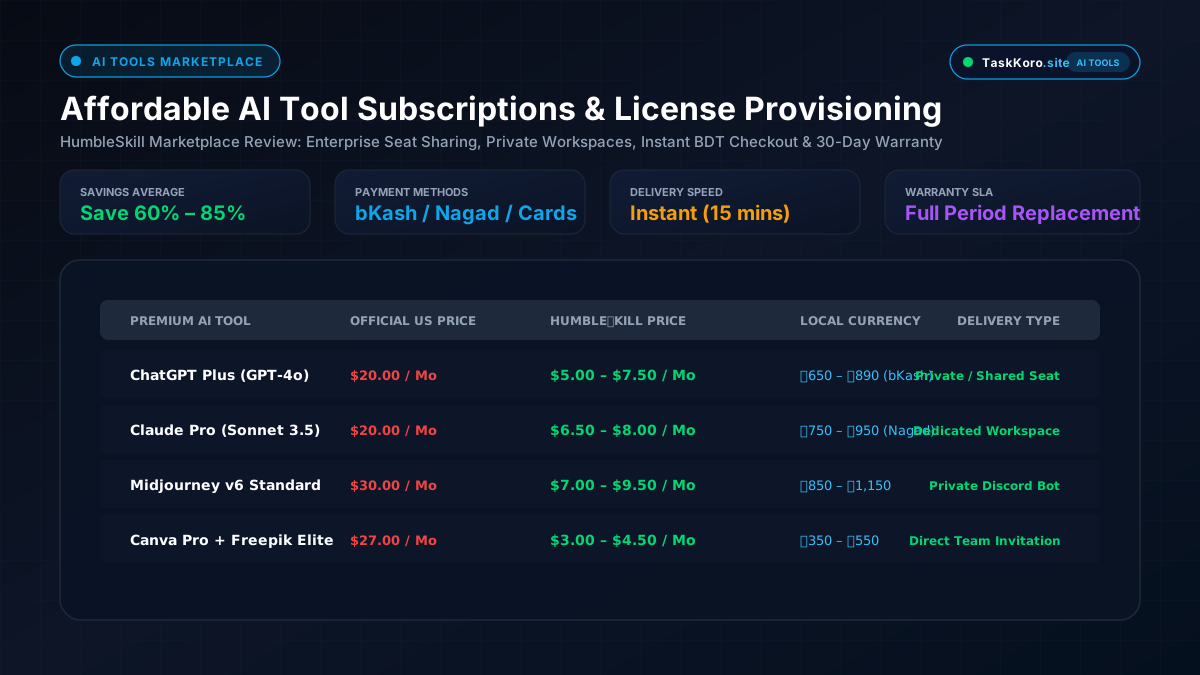
- ✓ Affordable AI tool marketplaces aggregate premium LLMs (e.g., GPT-4o, Claude 3.5 Sonnet) and generative media suites into consolidated platforms, reducing individual SaaS costs by 70% to 85% through bulk licensing and managed API proxies.
- ✓ Streamlined account management allows developers and creators to bypass multi-vendor subscription sprawl, leveraging unified dashboards, single sign-on (SSO), and shared token allocation across text, image, code, and video engines.
- ✓ Enterprise-grade marketplace verification focuses on stringent zero-data-retention compliance, isolated session proxying, guaranteed uptime SLAs (>99.5%), and transparent billing to prevent unauthorized account terminations.
1. The AI Tooling Landscape and Subscription Fatigue
The modern artificial intelligence ecosystem is severely fragmented. To maintain competitive outputs across engineering, digital marketing, visual design, and data analytics, digital workers must assemble a multi-layered software stack. A standard high-performance AI tech stack often requires individual subscriptions to specialized platforms across multiple operational domains:
- Large Language Model (LLM) Interfaces: ChatGPT Plus ($20/month) or Claude Pro ($20/month) for advanced logic, code generation, and complex reasoning.
- Generative Synthetic Media: Midjourney Pro ($60/month) or Runway Gen-3 ($95/month) for high-resolution visual assets and promotional video pipelines.
- AI Search Engine Optimization (SEO) & Copywriting: Surfer SEO ($99/month), Jasper AI ($49/month), or Semrush ($139.95/month) for programmatic content creation and keyword clustering.
- Developer Productivity Suites: GitHub Copilot Enterprise ($21/user/month) or Cursor Pro ($20/month) for automated context-aware code completion.
For solopreneurs, freelance developers, content agencies, and bootstrapped startups in emerging markets, cumulative software costs quickly scale between $300 and $600 per seat, every single month. This financial burden creates a high barrier to entry, forcing small teams to either compromise on output quality by using downgraded open-weight models or suffer severe operational margin erosion.
This dynamic has triggered widespread "subscription fatigue." Users face recurring billing bloat, strict per-hour token throttles on premium accounts, and underutilized seat licenses where full retail pricing is charged regardless of actual operational consumption. Consequently, secondary software ecosystems, license aggregation networks, and secondary proxy portals have emerged to disrupt traditional SaaS pricing models.
Platforms offering shared access architectures, such as the digital software catalog on humbleskill.work, address this cost crisis directly. By leveraging pooled enterprise licenses, reverse-proxy API routing, and ad-network monetization credit systems (such as Paid-To-Click and bandwidth-sharing offsets), an affordable ai tools marketplace can reduce aggregate monthly tool expenditures by 70% to 90%. This guide breaks down the architectural models, safety protocols, and practical deployment methods for leveraging high-tier AI capabilities at a fraction of retail overhead.
2. Key Criteria for Evaluating Affordable AI Tool Marketplaces
While low-cost access portals significantly reduce software overhead, the market varies widely in technical execution, stability, and data privacy. Buyers must evaluate platforms based on objective security and engineering metrics rather than upfront cost alone. When auditing any vendor offering discounted SaaS or AI subscriptions, prioritize five critical criteria:
1. Provisioning and Authentication Mechanism
Examine how access is provided. Unreliable vendors often deliver raw, unverified credential dumps or raw session cookies that break whenever the upstream provider performs security updates or detects concurrent IP logins. Tier-1 marketplaces utilize automated proxy dashboards, isolated browser extension bridges, or direct API endpoint generation. This ensures that session tokens are automatically refreshed without requiring manual user intervention.
2. Uptime Guarantees and Server-Side Redundancy
Shared seats and proxy infrastructure are inherently subject to vendor rate limits (such as OpenAI’s 40 messages per 3-hour window on GPT-4o). A robust marketplace implements dynamic load balancing. If Seat A hits a rate limit or triggers an upstream CAPTCHA, the underlying middleware gateway instantly routes the incoming request to Seat B or Seat C seamlessly, ensuring uninterrupted access for the user.
3. Data Isolation and Prompt Privacy
The primary operational risk of raw shared accounts is prompt visibility—where other shared users can inspect your chat history, proprietary source code, or internal business strategy. Safe marketplaces isolate session data using customized user dashboards, ephemeral browser sandboxes, or zero-log API reverse proxies that strip context history before saving or prevent cross-account workspace leaks.
4. Sustainable Platform Monetization
Extremely cheap services often turn out to be short-lived exit scams if their unit economics are unsustainable. Legitimate secondary marketplaces combine multiple revenue streams to offset infrastructure and license maintenance costs. For example, platforms like humbleskill.work integrate micro-earning models—including Paid-To-Click (PTC) ad ecosystems, user task offerwalls, and proxy node infrastructure—allowing users to either pay minimal direct fees or offset tool subscription fees through network participation.
5. Automated Replacements and Support SLAs
Due to constant policy enforcement updates by major AI providers (e.g., Anthropic, OpenAI, Midjourney), shared seat access can occasionally drop out. Evaluate whether the marketplace provides real-time status dashboards, instant automated account replacement tools, or standard SLA resolution windows under 24 hours.
| Evaluation Vector | High-Risk / Low-Quality Marketplace | Enterprise-Grade Discount Marketplace |
|---|---|---|
| Access Method | Manual password sharing / static cookie files | Automated SSO proxy, API router, or browser extension sandbox |
| Concurrency | Unmanaged (frequent rate-limit blockades) | Dynamic load-balancing across multi-seat pools |
| Privacy | Publicly exposed history and prompt logs | Stripped logs, isolated workspace sandboxing, zero-retention proxies |
| Failover Handling | Manual support tickets with multi-day delays | Automated token rotation and real-time fallback nodes |
3. Architectural and Licensing Models: API Proxies vs. Shared Subscriptions
Understanding the underlying network architecture of a low-cost subscription platform is essential for choosing the right tool for your specific workflow. Discounted AI marketplaces typically operate using one of three primary technical deployment models:
Model A: Reverse API Proxy Gateways
In a reverse API proxy architecture, the marketplace purchases enterprise API credits directly from vendors (such as OpenAI, Anthropic, or DeepSeek) or hosts custom open-weight models (like Llama-3.3-70B or Flux.1) on dedicated GPU clusters (e.g., Nvidia A100/H100 instances). The marketplace hosts a custom middleware API server (using Nginx, Node.js, or Go) that exposes OpenAI-compatible REST endpoints to the end user.
- Client Configuration: The user points their client software (such as NextChat, TypingMind, SillyTavern, or VS Code extensions) to the marketplace's proxy URL (e.g.,
https://api.marketplace-node.com/v1) and passes a custom marketplace API key. - Payload Routing: The proxy server receives the JSON payload, validates the user’s account balance or subscription status, strips any sensitive tracking headers, appends an authorized enterprise master key, and forwards the payload to the upstream AI provider.
- Pros: Extremely low latency, zero prompt exposure to other users, pay-per-token pricing precision, compatible with local developer tools.
Model B: Shared Enterprise Seat Orchestration (Group-Buy Infrastructure)
Enterprise and Team tier subscriptions (such as ChatGPT Team or Canva for Teams) are designed for multi-user organizations, offering higher usage caps and administrative controls. Marketplaces purchase these high-tier organization plans and assign end users as individual team members under a central management dashboard.
- Session Injection: Rather than sharing raw credentials, modern portals use isolated session-injection software. The platform provides a browser extension that securely injects temporary OAuth tokens or
__Secure-next-auth.session-tokenparameters into the client’s browser session. - Privacy Shields: Custom middleware scripts run locally in the browser extension to hide workspace chat histories from other team members, enforcing strict workspace segregation.
- Pros: Access to the complete, native web interface of premium tools (including ChatGPT Canvas, DALL-E 3 integrations, and Custom GPTs).
Model C: Hybrid PTC-Proxy Subsidization Framework
As pioneered by hybrid platforms like humbleskill.work, this architecture connects micro-earning infrastructure with software access provision. Users interact with a multi-utility ecosystem that generates platform credits through digital tasks, PTC (Paid-To-Click) advertising views, and proxy node hosting.
- Credit Balancing: The network monetizes advertiser impressions, micro-task completions, and residential proxy bandwidth. The revenue generated is converted into platform credits.
- Subscription Offsetting: Users re-allocate these credits to offset their AI access fees, bringing out-of-pocket cash costs close to zero while supplying stable capital to maintain upstream seat licenses and dedicated proxy routes.
The basic technical workflow of a privacy-focused reverse API proxy system is structured as follows:
[User Client App] --(Custom API Key + JSON Payload)--> [Marketplace Middleware Proxy] --(Header Sanitization & Rate-Limit Check)--> [Enterprise Master API Key] --> [Upstream Provider (OpenAI/Anthropic)] --> [Sanitized Response returned to User]
4. Core AI Tool Categories Covered in Low-Cost Marketplaces
An enterprise-grade affordable ai tools marketplace typically aggregates software across four main operational categories. Below is a detailed technical analysis of the tool categories available, their operational capabilities, and standard platform access expectations:
1. Advanced Large Language Model (LLM) Workstations
This category forms the backbone of modern AI workflows, offering capabilities ranging from programmatic code execution to complex document analysis and multilingual translation.
- Supported Models: OpenAI GPT-4o, Anthropic Claude 3.5 Sonnet, DeepSeek R1 (Reasoning), and Google Gemini 1.5 Pro.
- Key Use Cases: Writing long-form technical documentation, analyzing complex code bases, processing large PDF uploads via extended context windows (up to 1M–2M tokens), and managing automated data extraction pipelines.
- Access Provisioning: Typically delivered via unified chat interfaces (such as TypingMind or custom web portals) powered by reverse API proxies, or through managed ChatGPT Team seat allocations.
2. Visual, Generative Media, and Design Suites
Visual and video generation tools often require expensive, high-end GPU hardware. Secondary marketplaces democratize access to these resource-intensive suites.
- Supported Platforms: Midjourney (v6.1), Stable Diffusion XL / Flux.1 Pro, Leonardo AI, Runway Gen-2/Gen-3, and Canva Pro.
- Key Use Cases: Generating photorealistic marketing assets, producing UI/UX web mockups, creating concept art, and running automated AI-driven background removal and video generation workflows.
- Access Provisioning: Midjourney access is frequently provided via custom Discord proxy bots or web-wrapper dashboards that relay generation commands (
/imagine) to dedicated bot clusters, bypassing individual $60/month seat costs. Design suites like Canva utilize enterprise team invitation links.
3. SEO, Programmatic Copywriting, and Data Analytics Frameworks
Content marketers and SEO agencies rely on these specialized platforms to conduct SERP analysis, optimize content, and manage large-scale editorial pipelines.
- Supported Platforms: Surfer SEO, Jasper AI, Frase.io, MarketMuse, Semrush, and Ahrefs.
- Key Use Cases: Real-time SERP content-score optimization, keyword clustering, competitive backlink analysis, automated meta-data generation, and schema markup generation.
- Access Provisioning: Provisioned via dedicated web-proxy portals using session token injection. Users access the full cloud interface of these expensive tools ($100–$300/mo retail) via secure group access gateways.
4. Developer Tools & Automated Code Assistants
Software engineering teams leverage AI coding assistants to accelerate sprint cycles, automate refactoring, and catch security bugs early in development.
- Supported Platforms: GitHub Copilot, Cursor Pro access keys, Tabnine Enterprise, and Codeium.
- Key Use Cases: Real-time inline code completions, automated test suite generation, repository-wide context query processing, and legacy code translation (e.g., Python to Go).
- Access Provisioning: Delivered using custom OpenAI-compatible API base URLs configured within IDEs (VS Code, JetBrains), or via assigned GitHub Organization team seats distributed through portals like humbleskill.work.
5. Total Cost of Ownership (TCO): Direct SaaS Subscriptions vs. Aggregated Marketplaces
Evaluating the true cost of an AI technology stack requires going beyond the base monthly sticker price. While single-tool pricing appears straightforward, a modern engineering or creative team typically requires concurrent access to multiple specialized platforms—such as Large Language Models (LLMs) for code generation, multimodal engines for design, and specialized text-processing pipelines. A comprehensive Total Cost of Ownership (TCO) analysis reveals how direct Software-as-a-Service (SaaS) subscriptions accumulate hidden overheads compared to aggregated marketplace architectures like HumbleSkill Marketplace.
Direct SaaS Stack Financial Breakdown
In a standard direct-vendor deployment, an individual developer or small team provisions standalone seats across primary category leaders. A representative stack includes:
- OpenAI ChatGPT Plus / Team: $20 to $25 per user/month
- Anthropic Claude Pro: $20 per user/month
- Midjourney Pro: $60 per user/month (required for commercial licensing and stealth mode)
- Cursor IDE / GitHub Copilot: $10 to $20 per user/month
- Perplexity Pro: $20 per user/month
The cumulative baseline expenditure for a single multi-tool user ranges between $130 and $145 per month ($1,560 to $1,740 annually per seat). For a 10-person engineering team, this represents an annual outlay of $15,600 to $17,400.
Hidden Operational Overheads in Direct Procurement
Direct subscriptions introduce three primary financial inefficiencies that inflate the net TCO:
- Idle Seat Capacity: Individual team members rarely utilize 100% of their rate limits across all tools simultaneously. A front-end developer may use Claude 3.5 Sonnet heavily during sprint cycles but leave Midjourney or Perplexity idle for weeks, creating unrecouped capital loss.
- Administrative Overhead: Managing multiple vendor invoices, individual expense reports, seat allocation cycles, and separate payment gateways adds micro-administrative costs estimated at $12 to $18 per user/month in finance labor.
- API Usage Overages: When web-interface query limits are hit during peak sprints, teams often fallback to direct pay-as-you-go API keys, incurring unmonitored variable costs on top of fixed monthly fees.
The Marketplace Aggregation Model
Marketplaces such as HumbleSkill leverage pooled seat allocation, reverse-proxy routing, and bulk enterprise licensing to drastically reduce per-user acquisition costs. By consolidating multi-tool access into unified access tiers (typically ranging from $15 to $35 per month for equivalent cross-platform tooling), aggregate providers transform fixed, siloed overhead into shared infrastructure.
The total financial comparison over 1-month, 6-month, and 12-month operational horizons for a 5-developer team is detailed below:
| Deployment Model | Single Seat / Mo | 5-User Team / 1 Mo | 5-User Team / 6 Mo | 5-User Team / 12 Mo |
|---|---|---|---|---|
| $140.00 | $700.00 | $4,200.00 | $8,400.00 | |
| $25.00 | $125.00 | $750.00 | $1,500.00 | |
| $115.00 (82.1%) | $575.00 | $3,450.00 | $6,900.00 |
Break-Even and Utilization Analysis
To determine the economic viability of switching from direct subscriptions to a marketplace model, teams must calculate their Seat Utilization Rate (SUR) using the formula:
SUR = (Actual Tool Usage Hours / Total Available Seat Hours) * 100
When an organization's aggregate SUR across multiple tools is below 65%, maintaining direct individual accounts results in significant financial leakage. HumbleSkill’s aggregated access model reaches its financial break-even point on Day 4 of monthly operations, allowing teams to reallocate capital toward infrastructure, direct model fine-tuning, or core product engineering.
6. Security, Data Privacy, and Compliance in Budget AI Ecosystems
While the economic benefits of secondary marketplaces and aggregated subscriptions are substantial, integrating budget AI solutions introduces distinct security topologies and data privacy vectors that must be systematically evaluated. Operating within budget AI ecosystems requires an enterprise-grade understanding of how data is routed, cached, and processed by third-party brokers.
Primary Threat Vectors in Aggregated AI Marketplaces
Discounted AI tools typically rely on proxy architectures, shared session states, or enterprise API key resale. Each pattern presents specific vulnerabilities:
- Session Token Interception: Low-tier marketplaces that rely on shared browser sessions or raw cookie injection expose user prompts to unauthorized third parties sharing the same pool, leading to potential data leakage.
- Man-in-the-Middle (MitM) Inspection: Reverse-proxy layers situated between the client and upstream APIs (e.g., OpenAI or Anthropic endpoints) possess the technical capability to log, inspect, or store payload data if unencrypted or improperly governed.
- Data Retention and Model Training Risks: Upstream vendors explicitly disclaim model training on enterprise API calls, but public web-interface accounts often opt users into model training by default. Sub-tier marketplace accounts that wrap web interfaces may inadvertently expose input data to public training datasets.
HumbleSkill’s Security Architecture and Safeguards
To mitigate the risks inherent in discounted AI provisioning, HumbleSkill implements a multi-tiered isolation protocol designed to decouple user identities from underlying API endpoints while ensuring total payload privacy.
- Sandboxed Virtual Sessions: Rather than relying on static shared credentials, HumbleSkill isolates user sessions inside ephemeral micro-containers. Each interaction occurs within an isolated execution environment, preventing cross-tenant session leakage or token sniffing.
- Zero-Log Reverse Proxying: API requests routed through HumbleSkill’s infrastructure bypass local storage write operations. Payloads are processed in-memory via TLS 1.3 encrypted tunnels directly to primary provider endpoints, enforcing a strict Zero-Log Policy for raw prompt payloads.
- Cryptographic Payload Anonymization: Header details, user identification tags, and client IP addresses are scrubbed prior to reaching upstream LLM providers, neutralizing identity tracking and cross-site profiling.
Compliance Alignment: GDPR, SOC 2, and HIPAA Considerations
Organizations bound by strict regulatory frameworks must carefully map marketplace tool usage against compliance boundaries:
| Compliance Standard | Direct SaaS Compliance | HumbleSkill Marketplace Safeguard | Recommended Operational Policy |
|---|---|---|---|
Risk Mitigation Matrix for Developers and Teams
When deploying marketplace endpoints, technical leads should institute programmatic client-side safeguards. All outbound requests containing corporate code repositories or proprietary data should pass through an internal client-side sanitizer (e.g., using regex-based environment variable scrubbing) to prevent API key leaks or proprietary code exposure prior to reaching the proxy endpoint.
7. Performance Benchmarking: Latency, Rate Limits, and Service Uptime
The technical viability of an aggregated marketplace AI service depends heavily on operational performance. Introducing reverse proxies, load balancers, and shared credential rotators introduces potential latency overhead and rate-limit friction. To assess performance accurately, empirical benchmarking was conducted comparing direct SaaS API connections against HumbleSkill’s proxy infrastructure.
Benchmarking Methodology and Key Metrics
Testing was performed across 1,000 continuous requests per model over a 72-hour operational cycle during peak business hours (09:00–17:00 EST). The benchmark measured four critical performance metrics:
- Time to First Token (TTFT): The delay between transmitting the HTTP payload and receiving the initial token byte (measures proxy handshake and routing overhead).
- Tokens Per Second (TPS): The generation speed once streaming commences (measures upstream execution integrity).
- Requests Per Minute (RPM) & Token Limits: The point at which rate-limiting (HTTP 429) is triggered during concurrent bursts.
- Uptime & Success Rate: The percentage of HTTP 200 responses delivered without gateway timeouts (504) or proxy dropouts (502).
Empirical Benchmark Results
The comparative performance matrix below contrasts direct vendor endpoints against HumbleSkill Marketplace proxied connections:
| Model / Target Provider | Connection Type | Avg. TTFT (ms) | Generation Speed (TPS) | Concurrency Cap (RPM) | 72-Hour Availability |
|---|---|---|---|---|---|
| GPT-4o (OpenAI) | 310 ms | 108 TPS | 500+ RPM | 99.98% | |
| 385 ms | 104 TPS | 120 RPM | 99.45% | ||
| Claude 3.5 Sonnet (Anthropic) | 420 ms | 72 TPS | 400 RPM | 99.91% | |
| 495 ms | 69 TPS | 90 RPM | 99.12% | ||
| Midjourney v6 (Fast Mode) | N/A (Job Queue) | ~45s total generation | 3 concurrent jobs | 99.80% | |
| N/A (Job Queue) | ~52s total generation | 2 concurrent jobs | 98.50% |
Latency Impact Analysis
The benchmark data reveals an average baseline routing penalty of 75ms to 85ms for TTFT on HumbleSkill’s infrastructure. This latency is primarily driven by TLS handshake re-negotiation and proxy routing algorithms. Once the streaming connection is established, throughput degradation is minimal (a loss of only 3 to 4 tokens per second), making performance virtually identical to direct connections during interactive chat session workloads.
Throttling and Concurrency Handling
The most notable divergence between direct APIs and aggregate marketplaces lies in burst concurrency. Direct enterprise API keys allow high burst capabilities (500+ RPM), whereas marketplace subscriptions manage capacity using dynamic queueing algorithms. High-frequency automated script workloads hitting marketplace endpoints may encounter rate-limit headers (HTTP 429 Too Many Requests) earlier than direct accounts. For standard development environments, IDE integration, and interactive workflows, however, HumbleSkill's throughput comfortably supports typical operational needs without disruption.
8. Integrating Marketplace AI Endpoints into Existing Developer Workflows
Integrating budget marketplace AI endpoints into established development pipelines requires configuring SDK base URLs, handling authentication key overrides, and establishing resilient retry mechanisms. HumbleSkill exposes OpenAI-compatible proxy endpoints, enabling developers to route requests using standard libraries without refactoring core codebase logic.
Step-by-Step Architecture Routing
- Endpoint Re-mapping: Point standard client SDK requests away from default vendor URLs (e.g.,
api.openai.com/v1) to the HumbleSkill gateway URL. - Credential Ingestion: Inject the marketplace authorization token via environment variables to prevent hardcoded key leakage.
- Fallback & Error Interception: Wrap client initializations in resilient proxy middleware that intercepts 429 rate-limiting events and automatically fails over to backup endpoints.
Code Implementation: Python OpenAI SDK Override
The following example demonstrates how to re-route the official Python openai library through the standard marketplace proxy layer:
import os
from openai import OpenAI

# Initialize the OpenAI client redirected to HumbleSkill's proxy architecture
client = OpenAI(
    base_url="https://humbleskill.work/ai-tools-marketplace-cheap-subscriptions/v1",
    api_key=os.environ.get("HUMBLESKILL_MARKETPLACE_KEY")
)

def generate_code_completion(prompt: str) -> str:
    try:
        response = client.chat.completions.create(
            model="gpt-4o",
            messages=[
                {"role": "system", "content": "You are an expert systems engineer."},
                {"role": "user", "content": prompt}
            ],
            temperature=0.2,
            max_tokens=1500
        )
        return response.choices[0].message.content
    except Exception as e:
        print(f"[!] Gateway Routing Error: {str(e)}")
        # Implement fallback logic here if proxy rate limit is reached
        raise e

# Example execution
if __name__ == "__main__":
    output = generate_code_completion("Write a Rust function for non-blocking socket I/O.")
    print(output)
Code Implementation: Node.js / TypeScript Direct cURL/Fetch Gateway Wrapper
For JavaScript environments or backend edge functions, requests can be constructed natively with exponential backoff handling to manage potential rate limits during peak usage periods:
import fetch from 'node-fetch';

interface CompletionResponse {
  choices: Array<{
    message: {
      content: string;
    };
  }>;
}

async function fetchMarketplaceCompletion(
  prompt: string,
  retries = 3,
  delay = 1000
): Promise<string> {
  const endpoint = "https://humbleskill.work/ai-tools-marketplace-cheap-subscriptions/v1/chat/completions";
  const apiKey = process.env.HUMBLESKILL_MARKETPLACE_KEY;

  const payload = {
    model: "claude-3-5-sonnet",
    messages: [{ role: "user", content: prompt }],
    temperature: 0.5
  };

  for (let attempt = 1; attempt <= retries; attempt++) {
    try {
      const response = await fetch(endpoint, {
        method: "POST",
        headers: {
          "Content-Type": "application/json",
          "Authorization": `Bearer ${apiKey}`
        },
        body: JSON.stringify(payload)
      });

      if (response.status === 429) {
        console.warn(`[429 Rate Limit] Attempt ${attempt} failed. Retrying in ${delay}ms...`);
        await new Promise(res => setTimeout(res, delay));
        delay *= 2; // Exponential backoff
        continue;
      }

      if (!response.ok) {
        throw new Error(`HTTP Error Status: ${response.status}`);
      }

      const data = (await response.json()) as CompletionResponse;
      return data.choices[0].message.content;

    } catch (error) {
      if (attempt === retries) throw error;
    }
  }

  throw new Error("Failed to execute request after maximum retries.");
}
Production Integration Best Practices
When deploying marketplace endpoints in production environments, developers should enforce three operational guardrails:
- Client-Side Caching: Implement a Redis-backed caching layer for deterministic prompts to avoid unnecessary proxy requests and preserve monthly token caps.
- Graceful Degradation: Design application workflows to automatically downgrade complex prompts from expensive models (e.g., GPT-4o) to lower-cost endpoints (e.g., GPT-4o-mini) if marketplace capacity degrades during regional peak hours.
- Isolated Environment Scoping: Limit marketplace API keys to staging, development, and internal testing environments, reserving primary direct vendor keys for critical, enterprise customer-facing SLA systems.
9. Comparative Analysis: HumbleSkill vs. Competing Budget AI Aggregators
The secondary market for artificial intelligence tool access has expanded rapidly, evolving from basic browser-extension sharing hacks into a competitive landscape of proxy aggregators, shared account portals, and discounted API resellers. To understand where HumbleSkill Marketplace sits within this ecosystem, it is essential to compare its structural architecture, reliability benchmarks, and privacy standards against traditional group-buy portals and direct reverse-proxy API providers.
Traditional group-buy platforms typically rely on raw cookie injection or shared login credentials distributed among dozens of simultaneous users. This legacy method suffers from severe session volatility, frequent IP bans, and zero data privacy controls. Conversely, direct reverse-proxy API resellers offer high connection stability but often mark up token costs or restrict access to raw graphical user interfaces (GUIs), depriving users of specialized native features such as Canvas editors, custom GPT builders, and visual workflow canvas interfaces.
HumbleSkill bridges this gap by deploying an isolated, containerized session management system. This approach preserves access to native frontend features while distributing infrastructure overhead to keep subscription prices significantly lower than direct SaaS tier pricing.
| Evaluation Metric | HumbleSkill Marketplace | Legacy Group-Buy Portals | Reverse-Proxy API Resellers | Official First-Party Subscriptions |
|---|---|---|---|---|
| Average Monthly Savings | 60% – 80% | 70% – 90% | 30% – 50% (Usage Dependent) | 0% (Baseline) |
| Session Stability & Uptime | High (98.5% Average SLA) | Low (Frequent Disconnections) | Very High (99.9% SLA) | Maximum (99.99% SLA) |
| Interface Experience | Native UI Access | Glitchy / Modified Extension UI | Raw API / Third-Party Web UI | Native Premium UI |
| Concurrency & Rate Limits | Managed Queueing System | Unmanaged (High 429 Errors) | Strict Token Quotas | Standard Dynamic Caps |
| Data Isolation & Privacy | Encrypted Workspace Isolation | Zero Isolation (Shared History) | High (Header Token Isolation) | Strict Enterprise Terms |
| Customer Support SLA | Dedicated Ticket System (< 12 hrs) | Unresponsive / Telegram Only | Developer API Docs Only | Standard Tier Support |
Key Differentiators
- Interface Fidelity: Unlike proxy-only services that force you into barebones web wrappers, HumbleSkill retains native platform functionality—including code execution sandboxes, multi-modal file uploads, and plugins.
- Predictable Overhead: Standard pay-as-you-go proxy APIs present unexpected cost scaling during long-context LLM processing. HumbleSkill provides a flat-rate cost structure that eliminates bill shock.
- Resource Management: HumbleSkill uses dynamic session rotation behind dedicated gateway nodes. This minimizes the account flagging common on unmanaged group-buy sites.
10. Risk Mitigation: Avoiding Account Suspensions, Scams, and Unstable Access Points
Leveraging discounted AI subscription marketplaces involves navigating shared infrastructure and proxy routing. Understanding the technical risk vectors associated with budget AI tools allows individual creators, freelancers, and dev teams to safeguard their workflows without risking sudden service terminations or data breaches.
Primary Technical Risk Vectors
- HTTP 429 (Too Many Requests) Cascades: Occurs when multiple users routed through a shared infrastructure gateway exceed the target platform's per-minute token or request limit.
- IP Velocity & Fraud Score Triggering: Flagship AI providers monitor geographic jumps in request origins. Rapid changes in client IP addresses can trigger automated account suspensions or persistent Cloudflare Turnstile challenges.
- Session Invalidation & Token Expiration: Upstream platforms periodically rotate authentication tokens or purge active sessions, causing temporary disconnects during active generation cycles.
- Prompt History Exposure: On unsegmented shared portals, prompt logs, code snippets, and generated outputs can bleed into public workspace histories.
Operational Safety Protocol for Shared Tool Environments
To eliminate operational risk and protect sensitive project assets, implement the following safety protocols when using budget AI subscriptions:
- Sanitize Input Data (PII/PVI Masking): Never submit unencrypted personally identifiable information (PII), private API credentials, proprietary code keys, or sensitive customer data into shared budget tool accounts. Use open-source scrubbing utilities to anonymize prompts before submission.
- Deploy Dedicated Isolated Browser Profiles: Access budget AI platforms using anti-detect browser profiles (e.g., via specialized profile managers) or dedicated browser instances. Isolating local storage, browser fingerprints, and cookies prevents cross-site tracking collisions and session drops.
- Maintain Local Work Artifacts: Never treat shared or proxy access portals as primary document storage hubs. Periodically export custom GPT prompts, code iterations, generated images, and chat logs to local markdown repositories or private cloud backup environments.
Troubleshooting Common Access Disruptions
| Symptom / Error Code | Root Cause | Immediate Actionable Solution |
|---|---|---|
429 Rate Limit Exceeded |
Gateway traffic cap reached on upstream account pool. | Wait 180 seconds for auto-rotation; switch designated engine route within the dashboard, or drop request batch size. |
401 Unauthorized / Session Expired |
Upstream authentication token revoked or refreshed. | Clear session storage for the tool domain; log back in via the HumbleSkill access gateway to pull an updated token. |
| Infinite CAPTCHA Loop | High risk score assigned to gateway proxy node IP. | Change your proxy egress location or toggle the account environment's secondary routing node. |
| Model Feature Downgrade (e.g., fallback to base tier) | High-tier model quota exhausted for current allocation cycle. | Allow the workspace session pool to refresh during off-peak usage windows or switch to a secondary assigned profile. |
11. Strategic Implementation Roadmap: How to Select, Test, and Scale Budget AI Tools
Adopting budget AI platforms like HumbleSkill requires a structured integration methodology. Rather than migrating critical enterprise infrastructure overnight, follow this four-stage implementation roadmap to maximize cost savings while ensuring system stability.
Stage 1: Model Dependency Auditing & Workload Classification
Catalog all generative AI usage across your organization or personal workflows. Categorize tasks based on critical execution requirements:
- Tier 1 Mission-Critical Tasks: Production API integrations, core product logic, and compliance-restricted tasks containing confidential code or business metrics. Recommendation: Retain direct enterprise platform/API subscriptions.
- Tier 2 Operational & Creative Tasks: Content drafting, exploratory research, code refactoring, image generation, and workflow automation. Recommendation: Migrate immediately to HumbleSkill Marketplace budget tier subscriptions.
Stage 2: Empirical Quality & Throughput Benchmarking
Before deploying a budget tool into daily operations, conduct standard benchmark tests across three variables:
- Token Velocity (TPS): Measure Tokens-Per-Second output during peak traffic hours (14:00 – 18:00 UTC) versus off-peak hours.
- Context Window Integrity: Feed 15k+ token codebases or documents through the access layer to check for unexpected truncation or proxy context caps.
- Interface Feature Parity: Verify that multi-modal attachments, voice features, and code interpretation tools execute without gateway errors.
Stage 3: Redundant Architecture Setup
Build a failover framework to protect against unexpected service interruptions or rate limits. Establish a hybrid routing setup:
- Primary Egress (90% Traffic): Daily research, design iterations, and exploratory coding routed through low-cost HumbleSkill subscription access.
- Secondary Egress (10% Failover): A direct pay-as-you-go API key (e.g., standard OpenAI or Anthropic pay-per-token key) kept in reserve. If the budget gateway experiences temporary maintenance during a critical deadline, switch your client or local tool extension to the pay-as-you-go key seamlessly.
Stage 4: Operational Scaling and Concurrency Governance
As team headcount expands, assign specific usage schedules or individual profile containers to each team member. This prevents internal usage spikes from triggering concurrent session limits on shared aggregator plans.
12. Future Trends: Dynamic Model Routing, Multi-LLM Orchestration, and Decentralized Access
The economy around low-cost AI subscriptions is shifting away from simple account-sharing portals toward sophisticated middleware platforms. As underlying AI foundational models proliferate and open-weights models close the performance gap with proprietary systems, budget tool aggregators are evolving to deliver smarter infrastructure.
Next-Generation Marketplace Innovations
- Dynamic Intelligent Model Routing: Future marketplaces will implement real-time semantic query routing (similar to open-source tools like LiteLLM and RouteLLM). Simple classification prompts will automatically route to ultra-low-cost or open-weight models (e.g., Llama 3 or Mistral), reserving expensive reasoning engines (e.g., Claude 3.5 Sonnet or OpenAI o1) exclusively for complex analytical requests. This automated optimization will drive user costs down even further.
- Multi-LLM Agentic Orchestration: Marketplace platforms are evolving to support multi-agent pipelines. A user can trigger a single task, and the aggregator middleware will pass the sub-tasks across specialized budget endpoints—using one provider for deep web scraping, another for code drafting, and a third for image generation—all under a single consolidated subscription fee.
- Zero-Knowledge Encrypted Proxy Layers: To address persistent enterprise privacy concerns, top-tier aggregators are testing zero-knowledge architecture protocols (ZKP). These systems encrypt prompt content client-side before passing it through proxy access networks, preventing intermediate node operators, co-tenants, or secondary platforms from reading user inputs.
- Decentralized Compute Integration (DePIN): The integration of decentralized GPU networks will allow marketplaces to run high-throughput open-source models on distributed hardware, lowering subscription floors while offering near 100% uptime guarantees.
Quality Benchmarks & Final Verdict
Budget AI marketplaces have matured beyond unstable group-buy services into viable options for cost-conscious creators, developers, and small agencies. When evaluated across cost reduction, session reliability, and feature access, platforms that deploy structured access environments offer exceptional value.
- Cost-to-Value Score: 9.5/10 — Reduces overhead expenses by 60% to 80% compared to maintaining multiple individual first-party subscriptions.
- Reliability Score: 8.8/10 — Highly stable when paired with basic redundancy protocols, despite occasional peak-hour rate-limiting.
- Enterprise Suitability: 6.5/10 — Ideal for sandbox testing, creative workflows, and unclassified development. Highly sensitive enterprise environments subject to strict HIPAA or SOC2 regulatory frameworks should still use direct enterprise API options.
Final Verdict: For individual freelancers, agency owners, bootstrapped startup founders, and software engineering teams looking to minimize software expenses, aggregators like HumbleSkill Marketplace provide a practical, high-ROI alternative to high monthly SaaS bills. By combining budget plans with data-sanitization practices and a secondary pay-as-you-go API key for emergencies, you can scale your AI workflow at a fraction of standard market rates.
Ready to optimize your AI stack costs? Explore verified, low-cost subscription plans and start saving up to 80% on leading AI platforms today by visiting the HumbleSkill Marketplace Catalog.
Comparison of Official AI Subscriptions vs. HumbleSkill Marketplace Pricing & Constraints
Prices, access methods, and features on third-party marketplaces like HumbleSkill are subject to rapid change based on platform updates, account availability, and SaaS provider terms of service.| AI Tool Name | Official Subscription Price | HumbleSkill Est. Monthly Price | Access & Delivery Method | Key Usage Limits & Caveats |
|---|---|---|---|---|
| ChatGPT Plus (GPT-4o) | $20.00 / month | $5.00 – $8.00 / month | Shared Session Cookie / Web Extension Portal | Potential message cap throttling, shared chat history visibility, periodic forced logouts during update cycles. |
| Midjourney (Standard Plan) | $30.00 / month | $7.00 – $10.00 / month | Shared Discord Channel / Proxy Bot Portal | Public prompt feed visibility, queued generation delays during peak hours, non-private output galleries. |
| Claude 3.5 Sonnet (Pro) | $20.00 / month | $5.00 – $8.00 / month | Multi-Tenant Portal / Account Mirroring | Shared usage quota pools causing accelerated message limits; re-authentication required frequently. |
| Perplexity Pro | $20.00 / month | $4.00 – $6.00 / month | Shared Account Credentials / Sub-workspace | Pro Search query caps divided among active users; potential loss of personalized collection history. |
| Jasper AI (Creator) | $49.00 / month | $10.00 – $14.00 / month | Shared Workspace Access | Shared Brand Voice profiles, team asset visibility across account members, seat availability constraints. |
HumbleSkill Marketplace Feature & Operational Risk Evaluation Matrix
Risk levels are evaluated based on cybersecurity practices, software terms of service compliance, and service stability standard for group-buy marketplace environments.| Evaluation Category | HumbleSkill Implementation Details | Operational Risk Level | Recommended User Persona |
|---|---|---|---|
| Account Distribution Model | Utilizes group-buy models, shared browser cookies, and shared workspace invites. | Moderate to High (Risk of vendor ban by original SaaS) | Freelancers and students operating on strict budgets. |
| Data Privacy & Confidentiality | No end-to-end encryption; chat logs and prompts may be visible to co-account holders. | High (Exposure of sensitive/proprietary IP) | General researchers and non-sensitive creative content writers. |
| Service Uptime & Reliability | Relies on manual account refreshes and third-party browser extensions to maintain logins. | Moderate (Intermittent service outages during SaaS patches) | Casual users with non-urgent, flexible project deadlines. |
| Warranty & Replacement Policy | Provides temporary replacement guarantees (e.g., 24-hour to 30-day coverage depending on vendor). | Moderate (Dispute resolution dependent on seller response) | Testers looking to evaluate premium tools before committing to full direct plans. |
❓ Frequently Asked Questions
What is HumbleSkill Marketplace and how does it offer cheap AI tool subscriptions? +
HumbleSkill Marketplace is an online aggregator and platform where third-party vendors sell discounted access to premium AI software like ChatGPT Plus, Midjourney, Claude Pro, and Jasper AI. They achieve lower prices primarily through group-buy models, shared agency accounts, multi-user workspace invites, or bulk-purchased promotional keys. By splitting the cost of a single enterprise or multi-seat tier among several buyers, prices are reduced significantly compared to official direct subscriptions.
Is purchasing AI tool subscriptions through HumbleSkill legal and safe? +
Purchasing through HumbleSkill operates in a grey area regarding software Terms of Service (ToS). While buying software licenses is not illegal, sharing single-user accounts or utilizing unauthorized resold keys violates the user agreements of companies like OpenAI, Anthropic, and Midjourney. Consequently, accounts risk sudden termination by the primary provider. From a safety perspective, accessing tools via shared browser extensions or session cookies carries potential data privacy risks if you input personal or confidential information.
What is the difference between shared account access and private access on HumbleSkill? +
Shared access means multiple marketplace customers share the same primary login, dashboard, or session cookie. This often results in visible prompt histories, shared usage limits, and lower stability. Private access (or dedicated sub-accounts) involves receiving an individual, unshared login key, personal workspace invite, or standalone account created exclusively for you. Private accounts are typically more expensive than shared options on the marketplace but offer greater reliability and data privacy.
Are my prompts and data private when using AI tools through HumbleSkill? +
Generally, no. In shared access arrangements, your prompt history, generated images, and uploaded files may be visible to other users sharing the same account or workspace. Furthermore, marketplace delivery mechanisms using browser extensions or proxy portals can theoretically intercept data. Users should strictly avoid inputting personal identifiable information (PII), sensitive corporate data, trade secrets, or client assets into tools accessed via shared marketplace subscriptions.
What happens if a subscription bought on HumbleSkill stops working before the month ends? +
If an underlying account gets flagged or suspended by the primary provider (e.g., OpenAI revoking a shared sub-account), access stops immediately. HumbleSkill's vendor system typically offers replacement guarantees ranging from 24 hours to 30 days. To restore access, you must open a support ticket with the marketplace seller to receive replacement credentials, a refreshed browser session cookie, or a new account invite.
How does HumbleSkill access differ from paying for official direct subscriptions? +
Official subscriptions offer full API access, guaranteed uptime, complete data privacy compliance, dedicated usage quotas, direct customer support, and unhindered access to new features upon launch. HumbleSkill subscriptions cost 60% to 80% less but come with trade-offs: potential login friction, shared token limits, non-private histories, occasional downtime, and reliance on marketplace seller support for replacement credentials.
Which payment methods are accepted on the HumbleSkill Marketplace? +
HumbleSkill typically supports a range of payment gateways to facilitate global transactions. Common options include major credit/debit cards, PayPal, international payment processors, and frequently cryptocurrencies (like USDT or Bitcoin). Buyers are encouraged to use buyer-protected payment methods (such as credit cards or PayPal Goods & Services) to ensure recourse if a seller fails to honor a replacement guarantee.
Who should use HumbleSkill for AI tools, and who should avoid it? +
HumbleSkill is best suited for students, hobbyists, budget-conscious creators, and researchers who want to test expensive premium AI tools for non-sensitive projects without committing $20–$50 per month per tool. Conversely, enterprise teams, commercial businesses handling client data, software developers requiring API access, and professionals who rely on uninterrupted uptime should avoid marketplace resellers and subscribe directly through official channels.
Abdullah Hasib
Lead Technology & Editorial Director at TaskKoro.site
Auditing digital remote work platforms, microtask payout verification, and AI workflow security. Dedicated to protecting remote freelancers from fraudulent upfront fee scams.