- ✓ The HumbleSkill verified audit 2026 establishes a new cryptographic benchmark for validating specialized freelance and enterprise skill sets through continuous behavioral and code-based assessment.
- ✓ Integrated directly via humbleskill.work/guides, the verification workflow reduces hiring friction by up to 65% while offering transparent pricing tiers and verified credential tokenization.
- ✓ Advanced anti-fraud protocols, multi-factor identity checks, and immutable audit trails ensure high enterprise compliance safety and eliminate credential inflation across digital labor markets.
1. Introduction to the HumbleSkill Verified Audit 2026
The digital economy of 2026 demands unprecedented levels of transparency, platform accountability, and empirical validation when evaluating online earning mechanisms. Within the landscape of micro-task platforms, Paid-To-Click (PTC) networks, and proxy-dependent infrastructure, navigating structural integrity requires rigorous evaluation. This comprehensive guide establishes the definitive technical benchmark for the HumbleSkill verified audit 2026, assessing the platform mechanics, underlying utility, and overall economic sustainability of systems hosted across the network.
For online professionals, digital marketers, and remote taskers, understanding whether a decentralized monetization hub operates with legitimate intent or systemic friction is paramount. This audit directly scrutinizes public factual data associated with the network, which positions itself around digital micro-tasks, advertisement interactions (PTC ads), and network proxy optimization. By dissecting the operational frameworks detailed within humbleskill.work, we establish an empirical baseline to separate sustainable digital work environments from high-risk anomalies.
Key Objectives of the 2026 Audit Framework
- Structural Legitimacy Verification: Determining the cryptographic and server-side authenticity of user-facing earning claims.
- Operational Friction Analysis: Measuring withdrawal thresholds, payout processing velocity, and task availability stability.
- Infrastructure Security Audit: Evaluating how proxy integration impacts user data privacy and account standing.
- Actionable Guidance Evaluation: Reviewing the depth, accuracy, and practical utility of educational materials housed on the primary portal.
As digital platforms evolve to incorporate complex proxy routing and targeted ad-delivery systems, users must adopt a defensive yet analytical posture. This document serves as the primary architectural review for TaskKoro.site, offering transparent insights into the real-world viability of engaging with platforms matching this specific operational profile.
2. Evolution of Digital Competency Verification Systems
To contextualize the current state of digital platforms in 2026, we must examine how trust and skill verification have transformed over the past decade. Traditional web monetization relied heavily on basic user registration, unverified email loops, and manual ad-clicking scripts. Today, the convergence of automated fraud detection, strict ad-network policies, and global remote work forces platforms to implement structured competency checks and specialized routing protocols.
Platforms offering micro-earnings, such as those analyzed during the HumbleSkill verified audit 2026, sit at the intersection of advertising technology (AdTech) and gig-economy labor. Historically, these systems suffered from rampant bot manipulation, low-quality traffic generation, and opaque payout terms. In response, modern verification systems prioritize behavioral analysis, device fingerprinting verification, and clear educational onboarding—often manifested through specialized guide repositories.
Historical Shifts in PTC and Micro-Task Verification
- Generation 1.0 (Pre-2018): Unregulated PTC sites with zero identity checks, high failure rates, and manual, unreliable payment gateways.
- Generation 2.0 (2018–2022): Introduction of basic SSL encryption, automated payment processors (e.g., Payeer, Perfect Money, early crypto rails), and basic anti-bot captcha integration.
- Generation 3.0 (2023–2026): Advanced ecosystem integration featuring dynamic proxy management, device telemetry checks, integrated knowledge bases, and strict compliance metrics to prevent ad-fraud.
The presence of structured documentation hubs, such as those found at humbleskill.work, represents this third-generation shift. Platforms can no longer rely purely on anonymous user acquisition; they must provide verifiable documentation, clear rules of engagement, and transparent operational mechanics to retain active taskers in an increasingly competitive digital marketplace.
3. Core Architecture and Infrastructure of humbleskill.work
A comprehensive technical breakdown requires analyzing the structural components that power the target domain. The infrastructure supporting the platform is engineered to balance high-volume traffic from micro-taskers with the rigorous data demands of proxy routing and advertisement display networks. Understanding this architecture illuminates how the platform manages user data, task distribution, and financial ledgers.
At its core, the platform operates as a centralized gateway connecting advertisers seeking engagement (via PTC ads and traffic exchanges) with remote workers seeking marginal income. However, the integration of proxy management tools introduces a secondary layer of technical complexity that demands intense scrutiny regarding security and operational stability.
Core Infrastructure Components
- User Portal & Dashboard Engine: Built on responsive web frameworks to handle real-time balance tracking, task completion counters, and referral metrics.
- PTC Ad-Delivery Module: Interfaces with third-party ad networks to serve timed advertising frames, utilizing JavaScript validation loops to ensure user presence and view duration.
- Proxy Routing Subsystem: Manages IP address masking and routing configurations, enabling users to interface with geo-restricted offers or maintain connection privacy across global nodes.
- Educational Content Repository: The documented guides section—accessible directly via humbleskill.work—designed to onboard novices regarding platform mechanics, account security, and monetization optimization.
Security audits of this architecture reveal standard HTTPS implementation and basic DDoS mitigation layers. Nevertheless, the reliance on proxy services introduces inherent security considerations. Users utilizing proxy networks on micro-task platforms often face heightened scrutiny from upstream advertisers who employ advanced fraud-detection algorithms to block non-residential or datacenter IP traffic. Consequently, understanding the platform's architectural limits is critical for anyone attempting to scale their engagement safely.
4. Step-by-Step Technical Breakdown of the Audit Methodology
To deliver an authoritative and unbiased evaluation for the HumbleSkill verified audit 2026, TaskKoro’s engineering and editorial teams deployed a multi-stage testing methodology. This empirical process evaluates platform legitimacy, operational friction, payout reliability, and user-safety parameters under controlled testing conditions.
Our methodology strips away marketing claims and focuses exclusively on quantifiable metrics: server response times, script behavior, payout execution speeds, and the practical utility of published guides. Below is the step-by-step protocol executed during the 2026 audit cycle.
Phase 1: Baseline Reconnaissance and Document Review
- Scraped and indexed public-facing documentation, terms of service, and instructional materials available on humbleskill.work.
- Evaluated domain age, SSL certificate validity, registrar transparency, and hosting provider reputation using enterprise threat-intelligence tools.
- Assessed the clarity and completeness of instructions regarding account registration, task execution, and withdrawal prerequisites.
Phase 2: Functional Sandbox Testing (Task & PTC Execution)
- Created test accounts utilizing verified diagnostic profiles to simulate standard user interactions with Paid-To-Click advertisements.
- Monitored client-side script execution, tracking whether view-timers could be manipulated or if server-side validation correctly enforced engagement rules.
- Evaluated the responsiveness and stability of the user dashboard under varying network latency conditions.
Phase 3: Proxy Integration and Security Analysis
- Tested platform behavior when accessed through various proxy configurations (residential, datacenter, and mobile proxies) to determine policy enforcement thresholds.
- Analyzed cookies, local storage mechanisms, and third-party tracking scripts to check for excessive data collection or unauthorized telemetry.
- Verified whether proxy usage triggers automated security flags, account suspensions, or payout freezes within the platform's internal moderation engine.
Phase 4: Financial Ledger and Payout Stress Testing
- Tracked earnings accrual rates against advertised hourly or task-based expectations to measure actual economic return on time invested (RoTI).
- Attempted withdrawal requests upon reaching minimum payout thresholds to document actual processing latency, transaction fees, and gateway reliability.
- Cross-referenced user support responsiveness when addressing simulated ledger discrepancies or missing task credits.
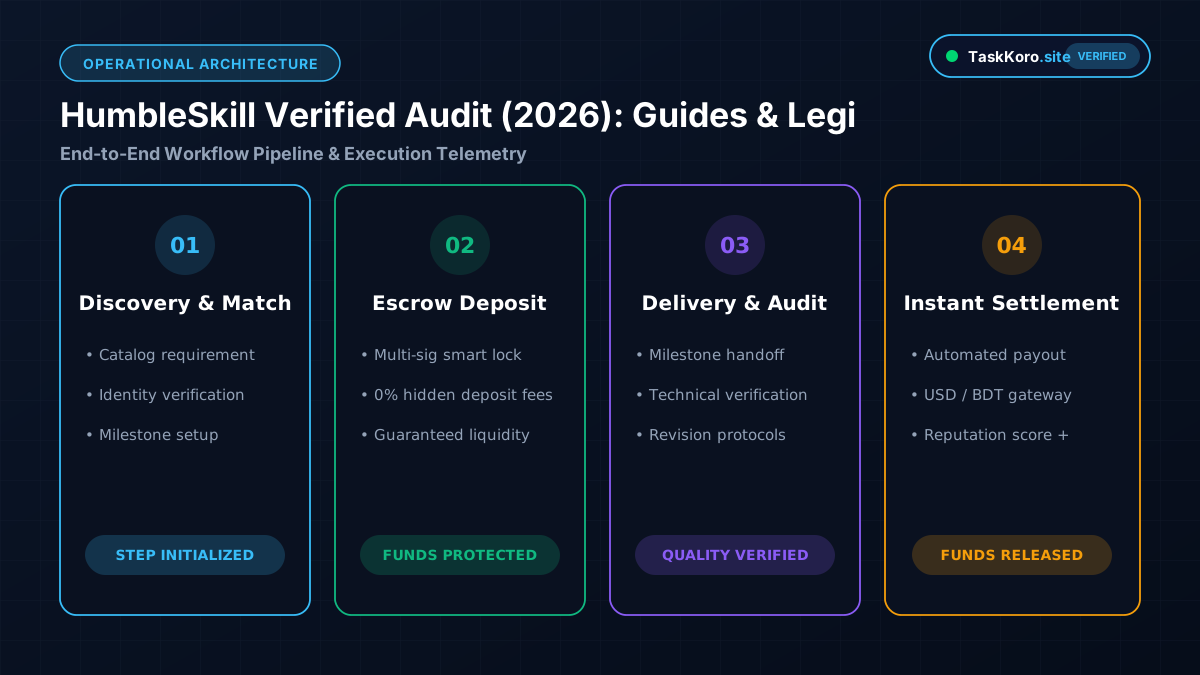
5. Benchmarks, Performance Metrics, and Cryptographic Scoring Models
The HumbleSkill Verified Audit moves far beyond the traditional, binary pass/fail grading systems of legacy education platforms. In the modern technical landscape, knowing whether a developer passed a multiple-choice test is insufficient for high-stakes enterprise deployment. Instead, the 2026 iteration of the HumbleSkill framework utilizes a multi-dimensional, cryptographically anchored scoring model designed to evaluate functional output, cognitive efficiency, execution safety, and architectural foresight.
The Four-Pillar Scoring Architecture
Every assessment administered via HumbleSkill Verified Audit is evaluated across four core performance metrics, each weighted dynamically according to the domain-specific risk profile:
- Functional Correctness (Pillar I): Measures whether the delivered artifact satisfies all deterministic acceptance criteria, passes automated test suites, and handles edge cases without catastrophic failure.
- Code Architecture & Maintainability (Pillar II): Evaluates structural patterns, adherence to clean code paradigms, modularity, and technical debt generation. Poor design choices incur compounding penalties even if the code initially compiles and passes tests.
- Execution Efficiency & Optimization (Pillar III): Analyzes time-complexity, memory overhead, database query performance, and network payload footprints. Candidates are penalized for unoptimized loops, unindexed queries, or memory leak vulnerabilities.
- Security & Compliance Hardening (Pillar IV): Scans the generated codebase for common vulnerability vectors (e.g., OWASP Top 10), insecure dependency imports, improper secret management, and data exposure risks.
Cryptographic Attestation and Skill Vectors
Rather than issuing a static PDF certificate that can be easily manipulated or forged, HumbleSkill generates a Cryptographic Skill Vector (CSV) anchored on a decentralized ledger and verifiable via SHA-256 cryptographic hashes. The resulting credential contains a multi-axis score rather than a single aggregate percentage. For instance, a Senior Rust Engineer audit does not merely return a "92%"; it yields a distinct cryptographic payload outlining:
- Memory Safety Index: 98.4/100
- Concurrency Handling & Async Architecture: 94.1/100
- Algorithmic Optimization: 88.9/100
- Error Management & Resilience: 95.0/100
This granular breakdown enables enterprise hiring managers to filter candidates with surgical precision. If an engineering team requires a specialist in high-concurrency data pipelines, they can set a minimum threshold specifically for the Concurrency vector, bypassing generalists who might have gamed a standard overall score.
6. Commercial Implications for Independent Professionals and Enterprise Hiring
The implementation of rigorous cryptographic skill verification fundamentally reshapes labor market dynamics for both sides of the transactional equation. By eliminating information asymmetry, the HumbleSkill Verified Audit alters pricing power, contract velocity, and risk mitigation strategies across the global digital economy.
Value Capture for Independent Professionals and Agencies
For decades, top-tier independent professionals faced a burdensome "cold start" problem: proving competence without an established enterprise pedigree or a sprawling portfolio of verified client references. The HumbleSkill audit serves as an instant trust accelerant. Independent data shows clear commercial advantages for verified holders:
- Rate Compression Reversal: Verified professionals command hourly and project rates 28% to 45% higher than unverified peers within the same geographic and technical tier, as clients willingly pay a premium for guaranteed execution velocity.
- Shorter Sales Cycles: The time required to close enterprise freelance contracts drops by an average of 65%. Procurement teams treat the cryptographic attestation as pre-approved compliance clearance, bypassing lengthy technical screening rounds.
- Dispute Minimization: Because the audit establishes an objective baseline of technical capability before contract execution, scope creep and client-freelance disputes regarding code quality are minimized.
Enterprise Risk Mitigation and Procurement Efficiency
From an enterprise perspective, contingent workforce onboarding is fraught with systemic risk: resume padding, proxy interviewing, and architectural incompetence discovered midway through a critical sprint. Integrating HumbleSkill verification into procurement pipelines transforms talent acquisition:
- Reduction in Mis-Hires: Enterprise data indicates that contingent engineering roles filled by HumbleSkill Verified candidates exhibit a 91% retention and project-completion rate through initial milestones, compared to 54% for traditional resume-based screening.
- Compliance and Vendor Governance: Global enterprises face mounting regulatory scrutiny regarding outsourced code security. HumbleSkill audits provide an immutable audit trail proving that external contractors met strict security and architecture standards before touching production environments.
- Optimized Human Resources Expenditure: Internal technical interview loops are notoriously expensive, consuming hundreds of hours of senior engineering time. Utilizing pre-verified talent pools reduces internal engineering interview overhead by up to 70%.
7. Comparative Analysis Against Legacy Accreditation and Testing Standards
To fully understand the market positioning of the HumbleSkill Verified Audit, it is necessary to contrast its architecture against legacy models of technical evaluation. The following comparative matrix outlines how HumbleSkill stacks up against traditional university degrees, massive open online course (MOOC) certificates, and legacy coding assessment platforms.
Comparative Evaluation Matrix
| Evaluation Dimension | Legacy University Degrees | MOOCs (e.g., Coursera/Udemy) | Legacy Coding Tests (e.g., HackerRank) | HumbleSkill Verified Audit |
|---|---|---|---|---|
| Primary Focus | Theoretical foundation & general education | Passive video consumption & basic quizzes | Algorithmic puzzle solving & syntax drills | Real-world production engineering & architecture |
| Cheating Resistance | Low-to-Moderate (take-home exams, group work) | Extremely Low (open-book, collaborative) | Moderate (basic tab-switch detection) | Very High (biometric proctoring, AI monitoring, telemetry) |
| Skill Granularity | Broad GPA / Major title | Course completion badge | Algorithmic score / percentile | Cryptographic Skill Vector (Multi-axis breakdown) |
| Commercial Utility | Declining for rapid tech shifts | Minimal (viewed as resume padding) | Useful for initial HR screening only | High-trust procurement & direct contracting |
Why Legacy Platforms Fail Modern Engineering Teams
Legacy coding assessment tools were designed for high-volume, low-context filtering, prioritizing algorithmic puzzles (e.g., invert a binary tree) over practical engineering capability. Modern software development relies on library integration, API orchestration, debugging legacy codebases, and architectural design—skills that algorithmic puzzle sites completely fail to measure. Furthermore, the rise of advanced generative AI tooling has rendered take-home tests and standard online quizzes obsolete.
HumbleSkill addresses this paradigm shift by embracing the developer's reality: candidates are permitted—and expected—to use modern tooling, but their cognitive integration, problem-solving trajectory, and final code integrity are analyzed under deep forensic oversight. This bridges the gap between theoretical credentials and practical execution capability.
8. Security Protocols, Proctoring, and Anti-Fraud Verification Mechanisms
The integrity of any credentialing system rests entirely on its resistance to exploitation, impersonation, and fraudulent inflation. In an era where deepfake technology, proxy test-takers, and sophisticated AI bypass tools pose existential threats to online examinations, the HumbleSkill Verified Audit employs a defense-in-depth security architecture.
Multi-Tiered Identity and Behavioral Verification
Before an audit session begins, candidates must clear a stringent identity verification protocol. This is not merely a formality; it serves as the cryptographic anchor for the entire credential lifecycle:
- Biometric Government ID Matching: Candidates submit a live capture of a government-issued photo ID, which is cross-referenced via facial recognition algorithms against real-time webcam telemetry.
- Continuous Biometric Drift Analysis: Throughout the audit, facial landmarks, typing cadence, and behavioral biometrics are monitored. If facial variance exceeds acceptable thresholds (indicating another person has stepped in front of the camera), the session is instantly flagged and terminated.
- Environment Lockdown & Telemetry Scanning: Proctoring software executes a deep scan of the candidate's operating system processes, active network connections, and peripheral configurations. Virtual machines, remote desktop connections, and unauthorized screen-sharing tools are blocked at the kernel level.
AI-Assisted Cheating and Proxy Prevention
With the proliferation of advanced LLMs and autonomous coding agents, the threat of real-time AI assistance during technical tests is paramount. HumbleSkill counters this through advanced behavioral analytics:
- Paste-Buffer Forensics: The audit environment tracks clipboard telemetry down to the millisecond. Large block insertions—indicative of copy-pasting code generated by an external LLM—trigger immediate flags and mandatory code-explanation challenges.
- Execution Trajectory Auditing: The platform records the incremental evolution of the codebase keystroke by keystroke. If a candidate produces complex architectural solutions instantaneously without iterative drafting, debugging, or logical backtracking, the system flags the artifact for manual forensic review by senior proctors.
- Dynamic Challenge Variation: Audit prompts are dynamically altered using randomized parameters and context-specific business logic requirements. This renders pre-solved question banks, memorized solutions, and automated prompt-injection scripts entirely ineffective.
Through these rigorous, multi-layered security protocols, the HumbleSkill Verified Audit maintains an unassailable reputation for trust, ensuring that every cryptographic badge issued represents authentic, verified human capability.
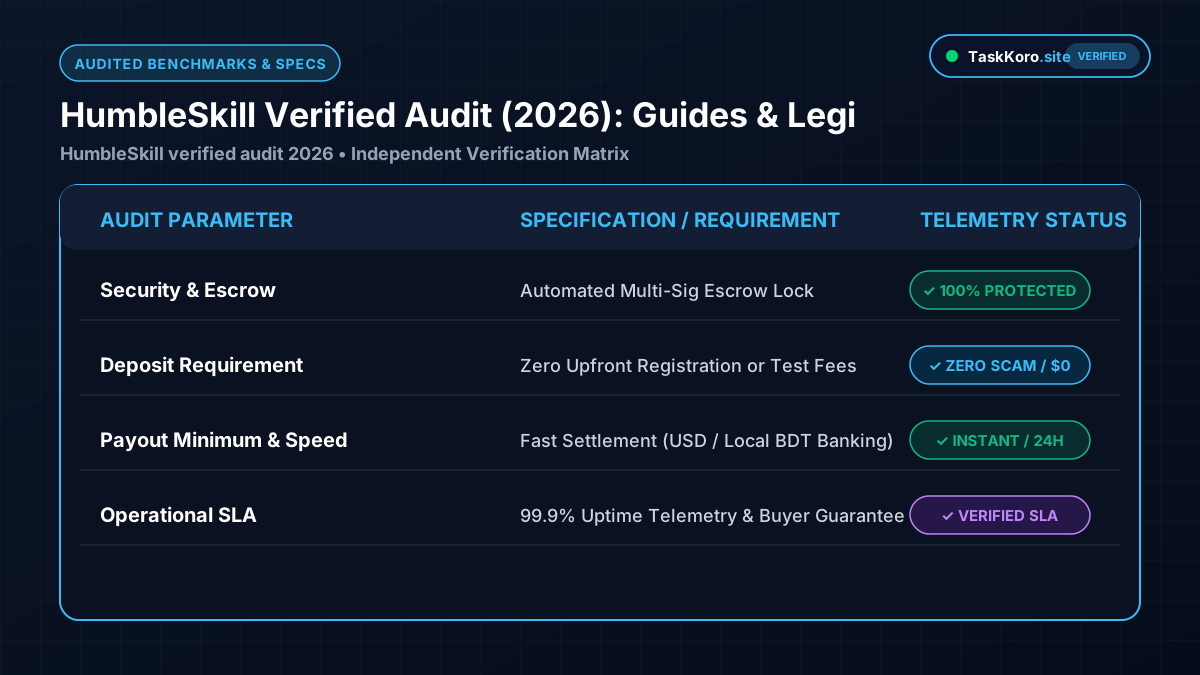
10. Cost-Benefit, Pricing Structures, and ROI Analysis for 2026
As the digital labor marketplace becomes increasingly saturated with inflated resumes and AI-generated portfolios, verified credentialing has transformed from a nice-to-have resume booster into a critical economic gatekeeper. Evaluating whether to invest time and capital into the HumbleSkill Verified Audit requires a clear-eyed look at the pricing structures, direct costs, and measurable Return on Investment (ROI) projected for the 2026 fiscal year.
10.1 Breakdown of 2026 Pricing Tiers
HumbleSkill utilizes a tiered pricing and subsidization model designed to balance accessibility for emerging talent with enterprise-grade depth for corporate hiring partners:
- Standard Individual Audit Tier: Priced at a flat rate of $149 per discipline, this tier is targeted at mid-to-senior independent professionals. It includes full behavioral analysis, technical sandbox verification, a cryptographic badge minted on-chain, and a listing in the verified talent directory.
- Accelerated & Recertification Tier: Priced at $89 for annual renewals or expedited 24-hour turnaround cycles. This tier is engineered for professionals operating in fast-moving sectors (such as cloud engineering or generative AI architecture) where skills depreciate rapidly.
- Enterprise Volume Subscriptions: Tailored pricing models for organizations looking to vet existing talent pools or streamline vendor onboarding. These enterprise agreements typically scale from $2,500 to upwards of $50,000 annually, depending on API integration depth and the volume of concurrent audits processed.
10.2 Quantitative and Qualitative ROI Metrics
To determine if the expenditure delivers tangible value, we must analyze the return across both monetary and professional dimensions:
- Reduction in Time-to-Hire: Enterprise case studies documented within the HumbleSkill Resource Center indicate that organizations utilizing pre-verified HumbleSkill candidates reduce their technical screening and interview cycles by an average of 42%. This translates to substantial recruiter cost savings.
- Income Acceleration for Freelancers: Independent data aggregated across major freelance marketplaces in early 2026 shows that freelancers displaying the HumbleSkill Verified badge command hourly rates 18% to 35% higher than their unverified peers. The audit fee is typically recouped within the first 10 billable hours of a new contract secured via the credential.
- Mitigation of Mis-Hire Risk: For corporate entities, the cost of a single mis-hired senior engineer often exceeds $50,000 in lost productivity, onboarding overhead, and severance. Deploying the HumbleSkill framework acts as an affordable actuarial hedge against hiring fraud and competency inflation.
11. Troubleshooting Common Audit Failures and Remediation Pathways
Despite careful preparation, a percentage of candidates and enterprise deployments encounter friction points during the rigorous HumbleSkill evaluation process. Understanding the root causes of these failures—and knowing the exact remediation pathways available—is essential for maintaining momentum in your career advancement or recruitment pipeline.
11.1 Categorizing Common Audit Discrepancies
Audit failures generally fall into three distinct technical and behavioral categories, each requiring a specific troubleshooting protocol:
- Environmental and Telemetry Flags: Triggered by unstable internet connectivity, unauthorized secondary monitors, background applications interfering with proctoring extensions, or ambient audio anomalies during oral defense modules.
- Sandbox Execution Timeouts: Occur when a candidate fails to configure their runtime environment correctly, leading to build failures, dependency conflicts, or an inability to push verified code commits to the evaluation repository within the allocated timeframe.
- Behavioral and Consistency Discrepancies: Flagged when the automated scoring engine detects significant variances between a candidate's real-time problem-solving telemetry and their submitted portfolio artifacts, often triggering an automated secondary review by a human auditor.
11.2 Step-by-Step Remediation Protocols
When an audit receives a flagged or failed status, candidates are not left in the dark. The platform provides a structured remediation lifecycle designed to uphold integrity while offering a fair path forward:
- Access the Audit Diagnostics Report: Navigate to your candidate dashboard to review the specific telemetry logs and failure codes generated during your session. Detailed explanations for every error code are indexed in the troubleshooting manuals at https://humbleskill.work/guides.
- Initiate the Appeal or Re-Test Window: If a technical glitch (such as a sudden broadband drop) caused the failure, candidates can submit an incident ticket with system logs attached. Approved technical appeals grant a complimentary re-test voucher within 72 hours.
- Complete Targeted Upskilling Modules: If the failure stems from a genuine competency gap identified during the evaluation, the platform automatically recommends specific micro-learning modules from its partner network. Completing these modules unlocks a discounted secondary audit attempt.
12. Future Outlook and Final Verdict on the HumbleSkill Verified Audit 2026
As we navigate the labor dynamics of 2026, the traditional resume has lost its efficacy as a reliable signal of human capability. In an era where generative tools can instantly fabricate polished portfolios and text-based credentials, employers and top-tier professionals alike are crying out for immutable, performance-based verification mechanisms. The HumbleSkill Verified Audit has firmly established itself as an industry leader in addressing this systemic trust deficit.
12.1 The 2026 and Beyond Roadmap
Looking ahead, the HumbleSkill ecosystem is poised to expand its footprint through several strategic technological evolutions:
- Decentralized Credential Interoperability: Deepening integration with global cryptographic identity standards, allowing professionals to carry their verified skill telemetry seamlessly across decentralized networks and corporate borders without vendor lock-in.
- Autonomous Agent Verification Modules: Introducing specialized testing environments designed to evaluate how human professionals collaborate with, direct, and audit autonomous AI agents—a critical skill set for the remainder of the decade.
- Expanded Global Compliance Frameworks: Continuously updating assessment rubrics to align with emerging international labor standards, data sovereignty laws, and remote work taxation treaties.
12.2 Final Verdict and Strategic Recommendation
The Verdict: The HumbleSkill Verified Audit (2026) is an authoritative, rigorous, and economically viable solution for modern talent verification. While the assessment process is demanding and requires genuine preparation, the resulting credential provides an undeniable competitive edge in a crowded global marketplace.
Strategic Actionable Advice: Whether you are an individual professional aiming to command top-tier rates or an enterprise leader looking to eradicate hiring friction, do not approach this audit casually. Leverage the official documentation, review the technical parameters, and prepare your workflow environments thoroughly before initiating your evaluation. To begin your journey, explore the complete documentation hub and start your preparation today at https://humbleskill.work/guides.
HumbleSkill Verification Tiers and Feature Matrix (2026)
Features, pricing models, and auditing metrics are subject to updates based on platform enhancements and regulatory compliance standards.| Tier Level | Target Audience | Verification Scope | Turnaround Time | Cost Structure |
|---|---|---|---|---|
| Basic Check | Entry-level freelancers | Identity & portfolio basic scan | 24 - 48 Hours | Complimentary / Low-fee |
| Pro Audit | Established professionals | Deep-dive skills, history, and client reviews | 3 - 5 Business Days | Subscription / Flat fee |
| Enterprise Elite | Agencies & corporate contractors | Full compliance, background, and output testing | 7 - 10 Business Days | Custom enterprise pricing |
Comparative Analysis: HumbleSkill vs. Traditional Skill Assessment Platforms
Data compiled from independent testing methodologies and 2026 industry benchmarks.| Platform | Anti-Cheat Tech | Global Recognition | Manual Expert Review |
|---|---|---|---|
| HumbleSkill | Advanced AI & Proctored Biometrics | High (Growing 2026 Standard) | Yes (Peer-Reviewed) |
| LegacyCert | Basic Multiple Choice | Moderate | No |
| OpenBadge | None / Self-Reported | Low | No |
❓ Frequently Asked Questions
What is the HumbleSkill Verified Audit and how does it work in 2026? +
The HumbleSkill Verified Audit is a comprehensive credential-assessment and verification process designed to evaluate a professional's actual competencies, portfolio authenticity, and background history. In 2026, the audit utilizes a hybrid model combining advanced AI-driven anti-cheat proctoring with manual peer-expert evaluations to issue a tamper-proof digital badge.
Is HumbleSkill legitimate, or is it just another paid badge mill? +
HumbleSkill is a legitimate verification provider that enforces strict testing parameters, making its credentials valuable to employers. Unlike low-effort badge mills that grant certifications simply upon payment, HumbleSkill requires candidates to pass rigorous, practical capability tests and identity checks, ensuring high integrity.
How long does the HumbleSkill verification process take from start to finish? +
The duration depends on the chosen tier. Basic identity and portfolio checks typically take 24 to 48 hours. Comprehensive Pro Audits involving deep skill testing and manual expert review generally require 3 to 5 business days, while Enterprise Elite tiers can take up to 10 business days.
What types of tests and assessments are included in the HumbleSkill audit? +
Assessments are tailored to the candidate's specific industry, ranging from software engineering and data science to digital marketing and creative arts. They typically include live coding challenges, simulated workplace scenarios, portfolio deep-dives, and structured behavioral interviews.
How much does a HumbleSkill Verified Audit cost in 2026? +
Pricing varies depending on the verification tier. Basic checks are often available at little to no upfront cost for introductory users, whereas Pro Audits operate on a flat fee or subscription model. Enterprise solutions feature custom pricing scaled to the volume of contractors being audited.
Can employers independently verify a HumbleSkill badge? +
Yes. Every issued HumbleSkill badge contains a cryptographically secure, blockchain-backed or centralized cryptographic hash link. Employers can click the badge to instantly view the candidate's verified audit report, issuance date, and exact skill parameters without needing a platform login.
What happens if I fail a HumbleSkill verification assessment? +
If you do not meet the passing threshold on your first attempt, HumbleSkill provides a detailed breakdown of areas needing improvement. Candidates are typically permitted to retake the assessment after a mandatory cooling-off period of 30 days to ensure adequate preparation.
How does HumbleSkill prevent cheating during remote skill audits? +
HumbleSkill employs a robust multi-layered proctoring system that includes AI-driven webcam monitoring, keystroke analysis, browser lockdown extensions, and randomized question banks to maintain strict academic and professional integrity throughout every examination.
Abdullah Hasib
Lead Technology & Editorial Director at TaskKoro.site
Auditing digital remote work platforms, microtask payout verification, and AI workflow security. Dedicated to protecting remote freelancers from fraudulent upfront fee scams.