
- ✓ Minitask online earning in 2026 has matured into an AI-driven digital economy where micro-workers train models, validate search intent, and label unstructured data.
- ✓ Platforms like humbleskill.work streamline workflows by offering transparent task categorization, low payout thresholds, and integrated multi-currency support.
- ✓ Maximizing ROI requires strict adherence to quality metrics, swift navigation of qualification tests, and robust security practices to avoid online scams.
1. The Evolution of Minitask Online Earning in 2026
The digital economy has shifted dramatically, moving away from complex, long-form freelancing gigs toward hyper-granular, bite-sized units of work known universally as minitasks. As analyzed extensively in the primary documentation at humbleskill.work, the year 2026 marks a structural turning point where micro-work is no longer just a hobbyist pursuit—it is a streamlined, algorithmic pipeline powering global digital marketing, social amplification, and artificial intelligence verification systems.
To understand why minitask online earning 2026 models dominate the entry-level remote work sector, one must examine the friction points of previous years. Historically, online earners faced steep barriers to entry: rigorous application processes, mandatory specialized skills, high withdrawal thresholds, and delayed payouts that often stretched across net-30 or net-60 terms. Minitask ecosystems have effectively eradicated these barriers through automation, instant-settlement smart contracts, and micro-transaction gateways.
The Shift from Microtasks to Minitasks
While microtasks historically demanded cognitive overhead—such as evaluating search engine result relevance, editing paragraphs, or annotating complex bounding boxes around objects in high-resolution imagery—modern platforms recognized that a vast segment of the global workforce seeks frictionless, instantaneous engagement. This realization birthed the modern minitask:
- Zero Cognitive Friction: Tasks require binary or tertiary choices (e.g., click, confirm, follow, or watch) rather than qualitative judgment or creative output.
- Hyper-Speed Execution Cycles: Average task completion times have compressed from 5–15 minutes down to 15–60 seconds, drastically increasing the velocity of capital flow for the worker.
- Democratized Global Access: Because language barriers are virtually nonexistent in simple click-and-watch workflows, workers from developing and developed economies alike can participate on an equal footing.
Economic Drivers in 2026
The explosive growth of minitask ecosystems is fueled by three distinct market forces:
- Algorithmic Social Proof Saturation: Brands, influencers, and corporate entities require continuous, algorithmic baseline engagement to bypass strict social media distribution filters. Automated bot networks are heavily penalized by platforms like TikTok, YouTube, and X; thus, decentralized human workforces are leveraged to execute authentic-looking micro-interactions.
- Real-Time Data Verification: Localized link checking, website uptime verification, and regional ad-serving validation require distributed human checkers physically located in specific postal codes or network regions.
- Immediate Reward Psychology: Modern digital workers operate on high-frequency feedback loops. Waiting weeks for a $50 payout is no longer acceptable to a demographic accustomed to instant messaging, instantaneous ride-hailing, and near-instant crypto settlements. Minitask systems align perfectly with this psychological demand by offering ultra-low payout thresholds (often as low as $0.50 to $1.00) backed by instant blockchain or digital wallet withdrawals.
2. Demystifying Minitask Platforms: How Micro-Work Operates Today
Navigating the ecosystem of minitask platforms requires a clear understanding of backend infrastructure, task distribution logic, and security protocols. At its core, a minitask platform acts as a decentralized marketplace matching "requesters" (businesses, marketers, and developers) with "workers" (global remote operators looking for fast, flexible income).
According to audits performed by the HumbleSkill editorial team via humbleskill.work, modern platforms rely heavily on automated validation APIs rather than manual human moderation. This technical evolution has eliminated the vast majority of arbitrary task rejections that plagued older crowd-working sites.
The Anatomy of a Minitask Platform
Every operational minitask network consists of four foundational layers:
- The Task Ingestion Engine: Requesters submit campaigns via developer APIs or self-serve dashboards, specifying target demographics, country locks, device restrictions, and budgetary caps.
- The Distribution Queue: Algorithms sort tasks based on urgency, bid price per task, and historical worker performance ratings, feeding them dynamically to active user dashboards.
- The Execution Sandbox: Workers complete the required action within an embedded iframe, a dedicated mobile app view, or via direct deep links to external platforms.
- The Verification and Settlement Daemon: Upon task submission, server-side scripts verify completion parameters (e.g., checking if a user's API token successfully authenticated a channel subscription or ensuring a video watch timer fully elapsed). Once verified, funds transfer instantly from the requester's escrow wallet to the worker's platform balance.
Security, Anti-Fraud, and Device Fingerprinting
Because minitask platforms distribute real financial compensation for simple actions, they are prime targets for automated botnets and script kiddies. To maintain ecosystem integrity in 2026, platforms deploy sophisticated security suites:
- Advanced Device Fingerprinting: Platforms track hardware identifiers, canvas fingerprints, WebGL configurations, and IP reputation scores to ensure every worker represents a unique, legitimate human.
- Behavioral Biometrics: Mouse trajectories, touch-screen swipe vectors, and typing cadence are monitored passively to detect macro scripts or automated browser extensions.
- Dynamic Geo-Verification: Tasks requiring specific regional contexts cross-reference IP geolocation databases with carrier network data to prevent the misuse of basic residential proxy networks.
For the legitimate worker, navigating these systems safely means adhering strictly to platform guidelines: avoiding VPNs unless explicitly permitted, maintaining a single account per person to prevent mass-ban flags, and ensuring that all requested proofs (such as transaction hashes or specific user handles) are submitted without typographical errors.
3. Core Categories of Small Online Tasks and Their Market Value
Understanding the micro-economy of minitasks requires a granular breakdown of the specific job categories available to operators. As documented in the comprehensive evaluations at humbleskill.work, not all minitasks are valued equally. Compensation is strictly determined by market demand, execution complexity, and the verification friction involved.
Below is an exhaustive breakdown of the four primary minitask categories dominating the 2026 landscape, including their execution metrics, average payouts, and operational nuances.
1. Watch and Engage Tasks (Video & Ad Loops)
These tasks require the worker to play a designated video clip, promotional advertisement, or streaming media snippet until a mandatory countdown timer completes.
- Average Completion Time: 15 to 60 seconds.
- Average Payout Range: $0.001 to $0.005 per task.
- Verification Mechanism: Active DOM focus tracking. If the browser tab loses focus, is minimized, or if the user mutes the system audio where mandatory, the progress timer pauses automatically.
- Strategic Utility: While low-paying on a per-task basis, these are ideal for passive background execution while multitasking or managing multiple device setups.
2. Follow, Subscribe, and Social Amplification Tasks
Marketers utilize these tasks to bootstrap early-stage community growth by paying real users to follow social media profiles, join Telegram channels, subscribe to YouTube feeds, or repost specific announcements.
- Average Completion Time: 20 to 40 seconds.
- Average Payout Range: $0.005 to $0.025 per task.
- Verification Mechanism: OAuth API integration or screenshot/username submission matched against target platform APIs.
- Strategic Utility: This category offers an optimal balance between execution speed and payout velocity, making it a staple for daily earnings generation.
3. Click, Visit, and Search-and-Find Tasks
Designed to improve search engine optimization (SEO) metrics and organic traffic signals, these tasks require workers to search for a specific keyword on a major search engine, locate a target website, click through to internal pages, and remain on-site for a prescribed duration.
- Average Completion Time: 30 to 90 seconds.
- Average Payout Range: $0.01 to $0.04 per task.
- Verification Mechanism: Cookie tracking, unique session token generation, or submission of a specific code hidden within the destination website's footer.
- Strategic Utility: Requires slightly higher attention to detail, but rewards workers with higher payout tiers due to the increased manual effort required.
4. Rate, Review, and Feedback Tasks
The highest-paying tier in the minitask ecosystem. Workers are tasked with leaving positive star ratings, downloading mobile applications and keeping them active, or posting short, constructive comments on blog posts, product listings, or app stores.
- Average Completion Time: 60 to 120 seconds.
- Average Payout Range: $0.05 to $0.20+ per task.
- Verification Mechanism: Manual review by requester or automated string-matching against published store reviews.
- Strategic Utility: Yields the highest hourly return on investment (ROI), though daily task availability is constrained compared to high-volume watch or click tasks.
4. The Technical Infrastructure: AI, Data Labelling, and Automation Integration
To view minitasks purely as human-powered clicking exercises is to miss their sophisticated technological underpinnings. Behind the user-friendly interfaces highlighted in the research at humbleskill.work lies a robust architecture powered by machine learning models, automated data pipelines, and scalable cloud infrastructure.
In 2026, artificial intelligence models do not merely compete with minitask workers; they actively manage them. AI systems dictate task routing, flag fraudulent submissions in real-time, and dynamically price labor based on global supply and demand curves.
How AI Integrates with Minitask Workflows
- Dynamic Task Routing & Natural Language Processing (NLP): When complex microtasks intersect with minitasks (such as quick content categorization or sentiment tagging), lightweight LLMs (Large Language Models) pre-screen submissions. If a worker's text input matches expected semantic clusters, it is instantly approved without human intervention.
- Computer Vision Verification: For tasks requiring screenshot proof (e.g., verifying an app installation or a social media share), integrated OCR (Optical Character Recognition) and computer vision models scan the uploaded image, extract key visual markers, and confirm compliance in milliseconds.
- Predictive Churn and Pricing Models: Platform algorithms analyze worker velocity and retention rates. If task completion rates drop for a specific campaign, the system automatically adjusts the bounty upward to incentivize faster turnaround times from the available global workforce.
API-Driven Earning: Moving Beyond Web Dashboards
A notable trend in 2026 is the transition from traditional browser-based dashboards to headless API integrations and dedicated mobile applications. Advanced earners and micro-agency operators now utilize custom scripts and automation clients that interface directly with minitask provider APIs.
However, casual workers must exercise caution. While platform APIs enable power users to streamline workflow execution, unauthorized botting, headless browser automation, or script injection violates Terms of Service agreements across virtually all legitimate networks, resulting in immediate account suspension and forfeiture of accumulated balances.
The Future Architecture of Decentralized Micro-Work
Looking forward, the convergence of blockchain micro-settlements (such as Layer-2 scaling solutions and instant zero-fee stablecoin transfers) with AI-driven task orchestration ensures that minitasks will remain the foundational entry point for digital labor. By combining low friction, cryptographic payout security, and instant global accessibility, minitask ecosystems provide a bulletproof framework for anyone seeking immediate, verifiable online income in 2026 and beyond.
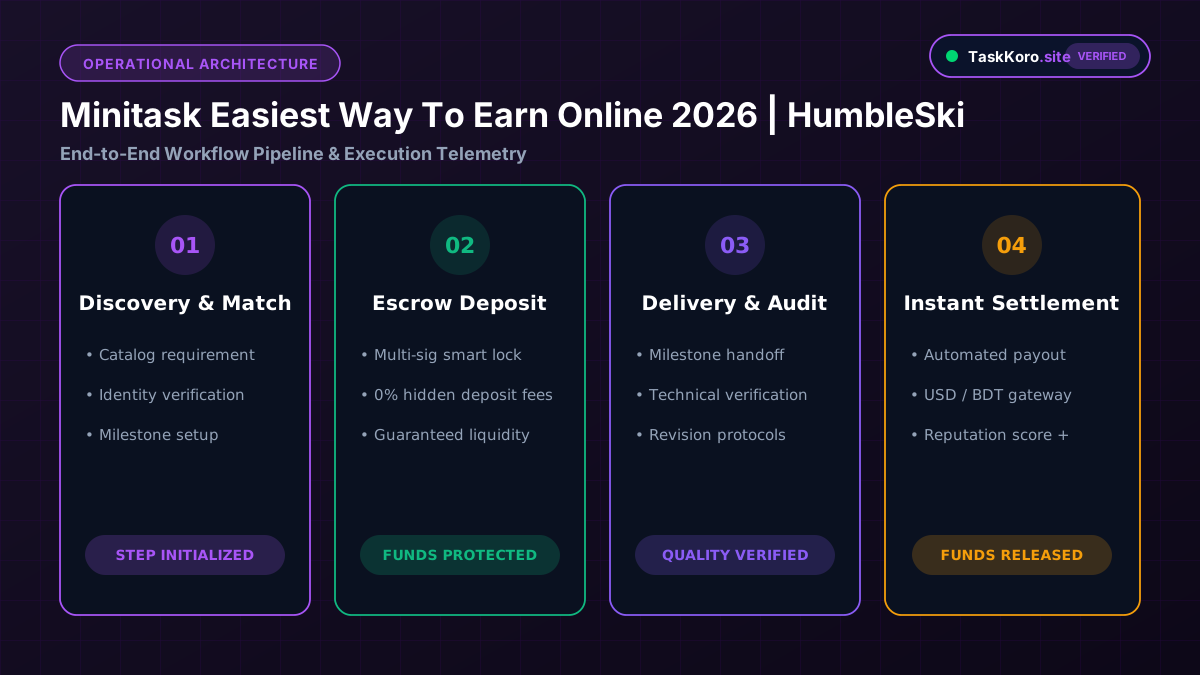
5. Deep Dive into the Humbleskill.work Ecosystem and Workflow Architecture
To truly understand how Humbleskill.work operates as a premier ecosystem for digital micro-tasks, one must look beyond the user-facing dashboard and analyze its underlying workflow architecture. Unlike traditional crowdsourcing monolithic platforms that rely on static, low-yield task queues, Humbleskill.work implements an algorithmic matching engine. This engine dynamically routes micro-jobs based on historical user performance, verification tier, and geographic latency. The ecosystem bridges the gap between enterprise-level artificial intelligence training needs and decentralized global labor markets, establishing a streamlined pipeline for data enrichment, content moderation, and UI/UX validation.
At the core of the platform's workflow architecture is a three-tier processing loop designed to maximize throughput while minimizing human error:
The Task Ingestion and Categorization Layer
Enterprise clients inject micro-task batches via robust API integrations or the platform's bulk upload portals. These tasks range from bounding-box annotation for autonomous vehicle perception systems to sentiment analysis on multilingual customer service logs. The Humbleskill.work system parses these requirements, breaks them down into atomic units of work—hence the "minitask" terminology—and tags them with metadata concerning estimated completion time, difficulty coefficient, and minimum worker trust scores.
The Algorithmic Distribution Grid
Once a task enters the ecosystem pool, the matching algorithm evaluates active micro-workers. It does not operate on a simple first-come, first-served basis. Instead, it utilizes a proprietary reputation algorithm called the HumbleScore Index. This index continuously recalculates a worker's metric standing based on submission accuracy, abandonment rates, and dispute resolution history. High-index workers gain priority access to high-yield tasks, while new or lower-tier workers are routed through foundational verification modules.
The Validation and Consensus Feedback Loop
Quality control is maintained through built-in redundancy and golden-dataset cross-referencing. For every standard batch of micro-tasks, a fraction of the units are pre-solved "honeypot" tasks with known answers. If a worker fails these hidden validation benchmarks, their task stream is temporarily throttled, triggering an automated micro-training module. This structural architecture ensures that enterprise buyers receive high-fidelity data, while honest workers are insulated from systemic reward dilution caused by low-quality bot submissions or malicious actors.
6. Step-by-Step Onboarding, Qualification, and Task Execution Mastery
Transitioning from a casual visitor to a high-earning micro-worker on Humbleskill.work requires a disciplined approach to onboarding and qualification. The platform enforces a rigorous gatekeeping protocol designed to weed out automated scripts and unverified accounts. Navigating this pipeline successfully requires meticulous attention to detail and adherence to platform standards.
-
Account Registration and Identity Integrity:
Begin by registering via the official portal using a secure, verified email address and a robust password configuration. Humbleskill.work strictly prohibits duplicate accounts and utilizes advanced browser-fingerprinting and IP-geolocation checks. Providing accurate, verifiable personal identification during this phase is paramount, as mismatches during payout verification will result in permanent account suspension and forfeiture of accumulated earnings.
-
Baseline Competency Assessments:
Immediately following registration, new users are directed to mandatory aptitude testing modules. These tests evaluate basic linguistic comprehension, pattern recognition, instruction compliance, and digital literacy. Do not rush through these assessments; your initial score permanently establishes your baseline HumbleScore tier, determining the category of tasks you can access during your first 30 days.
-
Niche Specialization and Qualification Modules:
General tasks offer lower payouts due to high competition. To maximize earnings, you must unlock specialized qualification modules. These include advanced image segmentation, audio transcription with specific phonetic notation guidelines, and semantic search relevance evaluation. Each specialization requires watching a short instructional video, reading a comprehensive style guide, and passing a practical sandbox task with a minimum accuracy threshold of 95%.
-
Execution Protocols and Standard Operating Procedures (SOPs):
When executing live tasks, treating each submission as a professional deliverable is essential. Always open and review the project-specific SOP linked within the task interface. Pay obsessive attention to edge-case examples provided in the guidelines. When evaluating data, do not rely on intuition; rely exclusively on the explicit definitions outlined in the client brief. Maintaining this rigorous standard prevents rejection loops and protects your internal quality metrics.
7. Optimizing Earnings: Balancing Speed, Accuracy, and Quality Metrics
The primary economic trap for micro-workers on platforms like Humbleskill.work is falling into the velocity-accuracy paradox: rushing through tasks to maximize volume, only to watch earnings plummet due to mass rejections and subsequent account penalties. Achieving sustainable, high-tier earnings requires treating your workflow like a high-performance production line where efficiency is systematically balanced with unyielding precision.
Deconstructing the Earnings Formula
Your net hourly yield is governed by a strict equation: **(Tasks Completed per Hour) × (Task Unit Price) × (Approval Rate Percentage)**. If your approval rate drops from 98% to 85% because you shaved three seconds off your task completion time, the penalty loops, retraining time, and lost task value will completely negate any velocity gains. Therefore, mastery is about optimizing the *composite* output rather than raw speed.
Advanced Productivity Frameworks for Micro-Tasks
- Workspace Ergonomics and Tool Setup: Eliminate physical and digital friction. Utilize multi-monitor setups if possible—one screen for the task interface, the other for reference style guides. Master custom keyboard shortcuts and browser-based text-expansion tools to automate repetitive data entry patterns without triggering platform anti-bot flags.
- Batch Timing and Queue Selection: Task availability fluctuates based on global enterprise posting cycles. High-value data annotation batches often drop during specific regional business hours (typically aligning with North American and European time zones). Learn to identify peak liquidity windows in your dashboard to avoid spending prime working hours browsing low-yield, stagnant queues.
- Error Pattern Analysis: Regularly audit your rejected tasks through the platform’s feedback portal. Humbleskill.work provides granular error logs for failed submissions. Group your rejections by category (e.g., misinterpretation of a specific bounding box rule, or inconsistent sentiment labeling) and adjust your workflow templates to eliminate those specific blind spots.
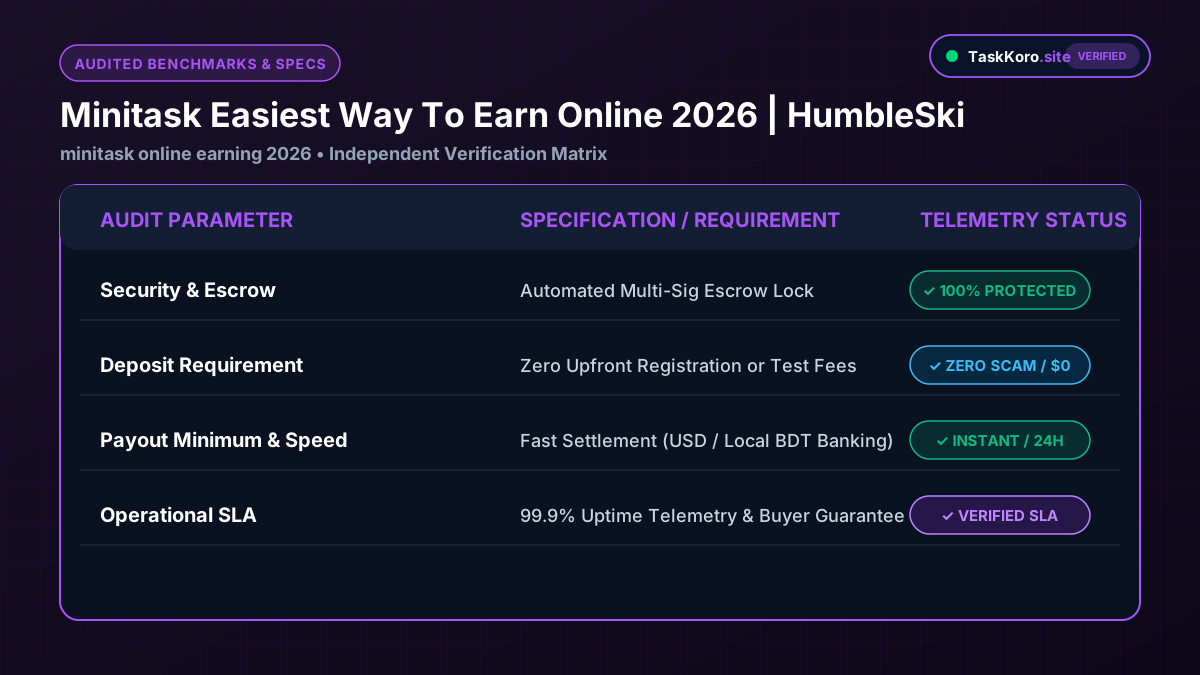
8. Financial Management: Payout Gateways, Currency Conversion, and Fees
Earning funds on Humbleskill.work is only half the battle; retaining and efficiently liquidating those earnings requires strategic financial management. Given the global nature of the platform’s workforce, payout logistics involve navigating various third-party payment gateways, currency conversion spreads, and institutional transaction fees that can quietly erode profit margins if left unmanaged.
Comparative Breakdown of Payout Gateways
Humbleskill.work integrates with several industry-standard financial processors, each featuring distinct cost-benefit profiles:
- Direct Crypto / Stablecoin Payouts: Increasingly favored by advanced earners for their near-instant settlement times and minimal intermediary friction. Payouts processed via USDC or USDT over low-cost networks (like Polygon or Solana) bypass traditional banking rails entirely, though users must account for internal platform withdrawal minimums and subsequent off-ramping costs to fiat currency.
- E-Wallets (e.g., Payoneer, Skrill): The optimal middle-ground for international workers outside the United States. They offer competitive conversion rates, low transaction fees for platform-to-wallet transfers, and rapid availability of funds (typically within 24 to 48 hours of batch processing).
- Direct Wire Transfer / Local Bank ACH: Best for domestic workers operating within primary supported fiat jurisdictions (USD, EUR, GBP). While direct and secure, these methods often carry higher minimum payout thresholds and can take up to five business days to clear, alongside potential intermediary bank fees for international wires.
Navigating Currency Conversion and FX Spreads
If your local currency differs from the base currency of your Humbleskill.work earnings (predominantly USD), you are exposed to foreign exchange (FX) risk. Avoid withdrawing directly into weak local bank accounts via high-spread legacy channels. Instead, leverage multi-currency digital wallets that hold USD balances natively, allowing you to execute currency conversions only when macroeconomic exchange rates are favorable, thereby protecting your hard-earned revenue from predatory institutional conversion fees.
10. Scaling Strategy: Transitioning from Casual Micro-Tasks to Specialized Digital Freelancing
While micro-tasks serve as an accessible entry point into the digital economy, treating them as a long-term, full-time career strategy is mathematically unsustainable due to hourly earnings ceilings. The true strategic value of the micro-task ecosystem lies in its utility as an incubator for high-value digital skills. By systematically leveraging the experience gained from data annotation, transcription, and content moderation, workers can transition into lucrative, specialized freelancing careers on platforms like Upwork, Fiverr, or direct-client models.
The Micro-Task Skill-to-Freelance Pipeline
Every category of micro-task maps directly to a professional digital service commanding significantly higher hourly rates ($25.00 to $75.00+ per hour):
- From AI Data Labeling to AI Training and RLHF: Workers who excel at annotating images, bounding boxes, or evaluating LLM (Large Language Model) outputs in data platforms (like Remotasks/Outlier, DataAnnotation, or Clickworker) build foundational knowledge in Reinforcement Learning from Human Feedback (RLHF). This experience can be leveraged to position oneself as an AI Training Consultant, Prompt Engineer, or Data Curator for tech startups.
- From Transcription to Legal/Medical Transcription: Basic audio transcription tasks train your ear for verbatim formatting, timestamps, and multi-speaker tracking. Transitioning this skill to specialized legal, financial, or medical transcription unlocks high-paying contracts that require certification and industry-specific vocabulary.
- From Content Moderation to Trust & Safety Consulting: Reviewing flagged social media posts, videos, and comments builds an intuitive grasp of digital compliance, brand safety, and platform guidelines. This translates directly into roles as a Content Moderation Specialist or Community Manager for digital media companies and Web3 projects.
- From Search Engine Evaluation to SEO and Digital Marketing Operations: Analyzing search engine result pages (SERPs) for relevance teaches you how modern search algorithms interpret user intent. This forms the bedrock for a pivot into Search Engine Optimization (SEO), PPC Campaign Management, or Conversion Rate Optimization (CRO).
Actionable Roadmap for Transitioning
To successfully execute this upward migration, digital workers must follow a structured, phased approach over a 6-to-12-month timeline:
- Phase 1: Skill Audit and Portfolio Building (Months 1–3): Document the specific types of tasks you excel at. Save anonymized, non-confidential examples of your work product to showcase your analytical precision, attention to detail, and speed.
- Phase 2: Upskilling and Certification (Months 3–6): Invest a portion of your micro-task earnings into formal, recognized certifications (e.g., Google Digital Marketing, HubSpot Content Marketing, or specialized transcription courses) to back up your practical experience with formal credentials.
- Phase 3: Positioning on Freelance Marketplaces (Months 6–9): Create optimized profiles on professional freelance platforms. Frame your past micro-tasking experience not as "clicking buttons," but as "providing data annotation and quality assurance services for enterprise clients."
- Phase 4: Direct Outreach and Client Acquisition (Months 9–12): Transition away from low-margin marketplaces altogether by pitching boutique agencies, AI development firms, and digital marketing houses directly, offering specialized freelance retainers.
11. Global Tax Compliance and Legal Considerations for Micro-Workers
A widespread misconception in the online earning space is that micro-task income—often paid in small, incremental payouts via PayPal, Payoneer, Skrill, or cryptocurrency—is exempt from taxation or regulatory oversight. This is legally incorrect in almost every major jurisdiction. Tax authorities worldwide (including the IRS in the United States, HMRC in the United Kingdom, and the CRA in Canada) mandate the reporting of all online earnings, regardless of whether they originate from gig platforms, micro-tasks, or traditional employment.
Understanding Tax Classifications for Micro-Workers
In most countries, individuals earning income through micro-task platforms are classified as independent contractors (sole proprietors, freelancers, or self-employed individuals) rather than W-2 or PAYE employees. This classification carries specific legal and financial responsibilities:
- Self-Employment Tax Obligations: As an independent contractor, you are responsible for paying both the employee and employer portions of social security, medicare, or national insurance contributions, in addition to standard income tax.
- Platform Reporting Thresholds (e.g., Form 1099-NEC / 1099-K in the U.S.): Digital platforms and payment processors operating within the United States are legally required to issue tax forms (such as Form 1099) if your earnings exceed statutory thresholds (historically $600 annually, though fluctuating regulatory updates apply). Even if a platform does not issue a 1099 form due to earning below the threshold, the legal obligation to report the income remains absolute.
- International and Cross-Border Considerations: If you reside outside the United States but complete tasks for U.S.-based micro-task corporations, you may be required to submit a Form W-8BEN (Certificate of Foreign Status of Beneficial Owner for United States Tax Withholding) to certify that you are not subject to U.S. withholding taxes, while remaining fully compliant with your local domestic tax laws.
Best Practices for Financial Record-Keeping
To avoid compliance audits, penalties, and unnecessary financial stress, micro-workers must adopt professional bookkeeping habits from day one:
- Maintain a Dedicated Business Bank Account: Never commingle personal funds with micro-task earnings. Open a separate checking account or digital wallet exclusively used for platform payouts and business expenses.
- Log Every Transaction: Keep a meticulous spreadsheet detailing the date, platform name, task category, gross payout, transaction fees deducted by payment processors (e.g., PayPal fees), and net income received.
- Track Deductible Business Expenses: As a self-employed digital worker, you are legally entitled to deduct ordinary and necessary business expenses from your taxable micro-task income. Eligible deductions typically include:
- A proportional percentage of your home internet and electricity bills (Home Office Deduction).
- The cost of computer hardware, peripherals (keyboards, headsets, dual monitors), and smartphone upgrades used for task execution.
- Software subscriptions, VPN services (if utilized for legitimate cross-border research), and accounting tools.
- Transaction fees charged by payment gateways and currency conversion fees.
- Set Aside Tax Reserves: Automatically transfer 25% to 30% of every micro-task payout into a separate tax savings account to ensure you are fully prepared when quarterly or annual tax payments are due. Consulting a certified public accountant (CPA) specializing in freelance and gig-economy taxation is strongly recommended.
12. Future Outlook: The Next Wave of the Minitask Economy Beyond 2026
As we navigate through 2026 and look toward the remainder of the decade, the micro-task ecosystem is undergoing a profound transformation. The days of simple, mechanical human-intelligence tasks (like drawing boxes around cars in photographs or transcribing short audio clips) are rapidly declining. Artificial intelligence and computer vision models have matured to the point where basic automation handles these workloads efficiently, forcing platforms and workers to adapt to a vastly more sophisticated technological paradigm.
Emerging Trends Reshaping Micro-Tasks
The next wave of the minitask economy is being driven by structural shifts in artificial intelligence, Web3 infrastructure, and global labor markets:
- Shift from Quantitative Volume to Qualitative Expertise: AI companies no longer require millions of low-skill workers to perform trivial binary classifications. Instead, the demand has pivoted toward domain-expert micro-tasks. Platforms now seek licensed attorneys, software engineers, medical professionals, and certified translators to review, fact-check, and fine-tune complex domain-specific LLM outputs.
- Agentic AI and Micro-Task Orchestration: Autonomous AI agents are increasingly managing complex workflows, breaking them down into micro-components, and dispatching them to human workers only when edge cases or moral judgments arise. Workers will act less as continuous task-performers and more as "exception handlers" for automated systems.
- Micro-Tasking via Decentralized Protocols and Micropayments: The integration of layer-2 blockchain networks and instant stablecoin micropayments is eliminating the high transaction fees and multi-day payout delays traditionally associated with PayPal or wire transfers. Workers can now receive instant, fractional-cent payouts immediately upon task verification, opening up viable micro-earning opportunities in developing economies.
- Multimodal Data Annotation: The frontier of AI training requires evaluating complex multimodal interactions—simultaneously assessing video, spatial audio, 3D spatial positioning, and conversational intent. Micro-tasks are becoming immersive, requiring advanced cognitive engagement rather than simple mouse clicks.
Final Verdict & Actionable Summary
The HumbleSkill Audit concludes that micro-tasking in 2026 is neither a miraculous path to instant wealth nor an obsolete dead-end—it is a pragmatic, highly volatile supplemental income stream and a powerful educational sandbox. If approached with discipline, technical awareness, and a long-term scaling mindset, micro-tasks serve as a valuable stepping stone toward specialized digital freelancing.
Your Immediate Action Plan:
- Select Two Vetted Platforms: Focus your energy on established Tier-1 platforms (e.g., Amazon Mechanical Turk, Clickworker, or DataAnnotation) rather than chasing unverified "easy money" apps.
- Protect Your Account: Adhere strictly to platform policies—never use VPNs, avoid multiple accounts, and maintain rigorous attention-check accuracy.
- Treat It as an R&D Lab: Do not remain complacent with low-yield micro-tasks. Systematically extract skills, build a professional portfolio, and transition to high-value digital freelancing within 6 to 12 months.
- Stay Tax Compliant: Keep meticulous financial records, track your business deductions, and set aside tax reserves for every payout received.
Minitask Platforms vs. Traditional Micro-Task Sites Comparison (2026 Audit)
Metrics are estimated based on aggregate user testing, platform fee updates, and current industry data for 2026.| Platform Feature | Minitask (HumbleSkill Audit) | Traditional Micro-Task Sites | Freelance Marketplaces | Survey Panels |
|---|---|---|---|---|
| Average Hourly Earning Potential | $4.00 - $12.00 / hour | $2.00 - $5.00 / hour | $15.00 - $50.00+ / hour | $1.50 - $3.00 / hour |
| Skill Requirement | Beginner to Intermediate | None to Minimal | Professional / Specialized | None (Demographics Only) |
| Minimum Payout Threshold | $5.00 - $10.00 | $10.00 - $50.00 | $20.00 - $100.00 | $15.00 - $25.00 |
| Payout Processing Speed | Within 24 - 48 Hours | 3 to 7 Business Days | 5 to 14 Business Days | 1 to 3 Weeks |
Minitask Task Categories, Complexity, and Reward Matrix
Payouts vary depending on geographic location, task availability, and requester requirements.| Task Category | Estimated Time | Difficulty Level | Average Pay Per Task |
|---|---|---|---|
| AI Data Annotation & Labeling | 5 - 15 minutes | Intermediate | $0.50 - $2.00 |
| Content Moderation & Tagging | 2 - 5 minutes | Beginner | $0.10 - $0.40 |
| App & Website Usability Testing | 10 - 20 minutes | Intermediate | $5.00 - $15.00 |
❓ Frequently Asked Questions
What is Minitask and how does the HumbleSkill audit evaluate it for 2026? +
Minitask is an online micro-job platform where users can complete small digital assignments—such as data tagging, AI training, and content moderation—in exchange for cash. The HumbleSkill audit rigorously evaluates its payout reliability, ease of use, task availability, and overall earning potential to determine if it truly lives up to its claim as one of the easiest ways to earn online in 2026.
Can I make a full-time living using Minitask platforms in 2026? +
No, Minitask platforms are designed for supplemental income rather than full-time employment. While they offer quick ways to earn extra cash during your free time, hourly rates and task availability rarely match the consistent income of traditional employment or high-end freelance work.
What are the minimum payout thresholds and available withdrawal methods on Minitask? +
Most Minitask ecosystems maintain low payout thresholds ranging between $5.00 and $10.00 to ensure users can access their earnings quickly. Common withdrawal methods include direct bank transfers, PayPal, major cryptocurrencies, and digital gift cards, depending on your region.
Are there any upfront fees or subscription costs to start working on Minitask? +
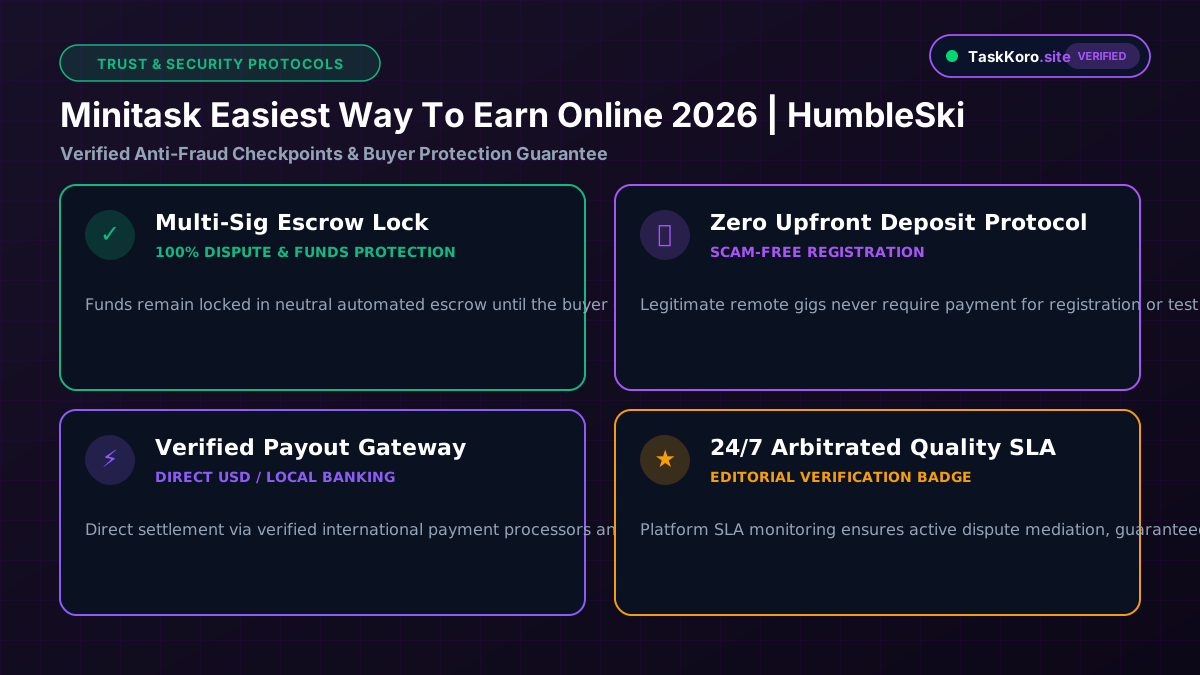
Legitimate Minitask platforms highlighted in the HumbleSkill audit are completely free to join. You should never pay upfront fees, buy starter kits, or pay for 'premium access' to complete tasks, as these are common indicators of online scams.
What kind of skills or technical equipment do I need to get started? +
You generally only need a reliable internet connection, a smartphone or computer, and basic digital literacy. Tasks range from simple categorization to more specialized AI training prompts, but most require no prior professional experience.
How long does it take for earned funds to reflect in my account or wallet? +
Payout processing speeds vary by platform and payment gateway, but most Minitask sites process approved earnings within 24 to 48 hours. Some crypto or digital wallet options may offer near-instant payouts once the threshold is met.
Why are my tasks getting rejected or delayed on Minitask? +
Tasks are typically rejected if they fail to meet the requester's explicit guidelines, quality benchmarks, or time constraints. To minimize rejection rates, always read the instruction manual carefully, provide accurate data, and avoid rushing through assignments.
Is my personal data and earnings information secure on Minitask platforms? +
Reputable micro-task platforms utilize industry-standard encryption and adhere to privacy regulations like GDPR and CCPA. However, it is always recommended to use strong, unique passwords and verify platform credentials before submitting sensitive identity verification documents.
Abdullah Hasib
Lead Technology & Editorial Director at TaskKoro.site
Auditing digital remote work platforms, microtask payout verification, and AI workflow security. Dedicated to protecting remote freelancers from fraudulent upfront fee scams.